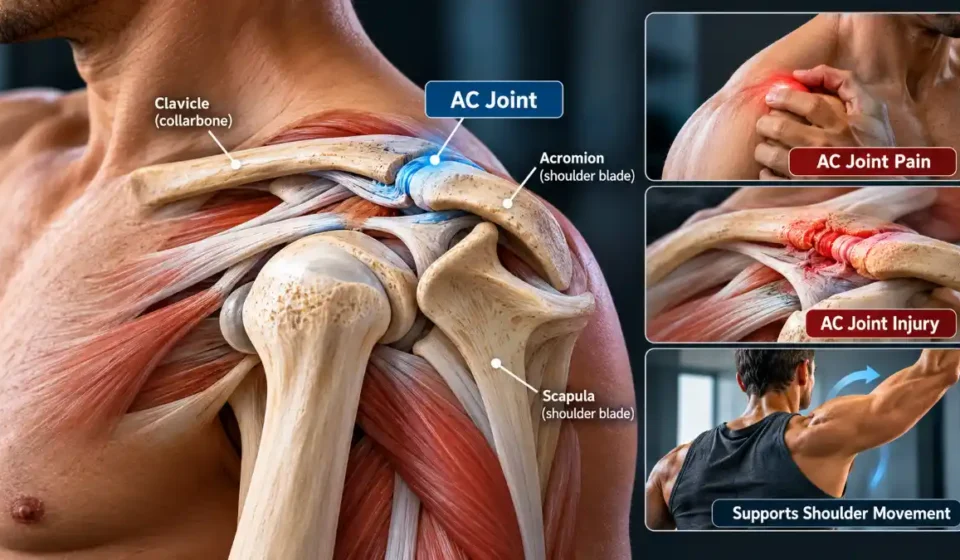

The acromioclavicular (AC) joint connects the acromion, a bony projection of the shoulder blade, to the outer end of the clavicle, or collarbone. It sits at the top of the shoulder and helps keep the shoulder girdle stable while allowing small adjustments between the collarbone and shoulder blade as the arm moves. Sprains, shoulder separation, and arthritis can affect this joint and cause pain near the top of the shoulder.
The AC joint is one part of a coordinated system that includes the scapula (shoulder blade), clavicle, muscles, ligaments, and the glenohumeral joint-the shoulder’s main ball-and-socket joint. Understanding how these structures work together helps explain the joint’s role in reaching and lifting, as well as why an injury here is different from a dislocated shoulder.
AC Joint Location and the Bones Involved
The joint forms where the lateral, or outer, end of the clavicle meets the acromion. The acromion extends from the scapula and creates the bony prominence at the top of the shoulder. The clavicle runs across the front of the upper chest, linking the breastbone to the shoulder region, while the scapula rests against the back of the rib cage.
You can often feel the meeting point as a small bump near the outer end of the collarbone. It is separate from the glenohumeral joint, which lies farther down and toward the front of the shoulder, where the upper-arm bone meets the socket of the scapula. The two joints have different structures and can be injured independently.
AC Joint Anatomy: Cartilage, Capsule, and Ligaments
The meeting surfaces of the clavicle and acromion are covered by fibrocartilage, a tough, flexible tissue that helps the joint tolerate pressure. A small fibrocartilaginous disc may also sit between the surfaces, although its size and condition vary. A joint capsule surrounds the connection, and its lining produces synovial fluid to lubricate the joint.
Several ligaments help keep the bones aligned. The acromioclavicular ligaments reinforce the capsule and limit excessive movement directly between the clavicle and acromion. The coracoclavicular ligaments connect the clavicle to the coracoid process, a hook-like projection of the scapula beneath the acromion. This ligament complex contains two parts, the conoid and trapezoid ligaments, which help suspend the shoulder blade from the collarbone and resist displacement.
Because these ligaments provide much of the joint’s stability, stretching or tearing them can change how the clavicle and shoulder blade sit in relation to each other. The amount of ligament damage helps determine the severity of a separation injury.
AC Joint Function During Shoulder Movement
The joint provides a stable but slightly mobile link between the collarbone and shoulder blade. It allows small gliding and rotational adjustments rather than large movements like those at the shoulder’s ball-and-socket joint. These adjustments help the shoulder blade change position as the arm rises, reaches across the body, or moves overhead.
The clavicle and scapula move in coordination with the muscles around them. The joint accommodates small changes between these bones, helping the shoulder girdle maintain alignment and transfer forces during lifting, throwing, and everyday activities. It does not independently power the arm; the glenohumeral joint, rotator cuff, and scapular muscles also contribute to shoulder movement and control.
Common AC Joint Injuries and Conditions
Sprains and shoulder separation
A sprain occurs when the supporting ligaments are stretched or torn. A common cause is a fall directly onto the outer shoulder or an impact during sports or an accident. Symptoms may include pain, tenderness, swelling, and discomfort when lifting the arm or bringing it across the chest.
A shoulder separation occurs when damage to the supporting ligaments allows abnormal movement between the clavicle and acromion. More significant injuries can also damage the coracoclavicular ligaments, allowing the collarbone to shift relative to the shoulder blade. A visible bump may develop at the top of the shoulder, but not every sprain causes an obvious deformity. The severity depends on which ligaments are injured and how much displacement occurs.
Arthritis
Arthritis can develop as cartilage wears down with age or after an earlier injury. Repeated loading may also contribute to joint irritation. Some people have degenerative changes without symptoms; others experience tenderness, stiffness, or pain at the top of the shoulder, particularly during certain movements or when reaching across the body.
Why Does AC Joint Pain Occur?
Pain in this area can follow a ligament sprain, a separation injury, or arthritis. A direct impact may cause sudden symptoms, while degenerative changes can produce discomfort gradually. Activities that load the shoulder or repeatedly bring the arm across the body may aggravate an already irritated joint.
Pain location alone cannot confirm the cause. Rotator cuff problems, inflammation around the shoulder, and neck conditions can create similar symptoms. Nearby structures can cause similar pain, so location is a clue rather than proof. A healthcare professional may consider the injury history, examine tenderness and movement, and use imaging when appropriate to identify the source.
Seek prompt medical assessment after significant trauma, especially if the shoulder looks deformed, pain is severe, or moving the arm is difficult. Persistent or worsening pain also deserves evaluation rather than assuming the joint is responsible.
AC Joint Separation vs. Shoulder Dislocation
A separation and a dislocation affect different joints. An AC joint separation disrupts the connection between the clavicle and acromion, usually through ligament injury. A typical shoulder dislocation occurs when the head of the humerus, or upper-arm bone, moves out of the glenoid socket.
| Feature | AC joint separation | Glenohumeral shoulder dislocation |
| Joint involved | Clavicle–acromion connection | Upper-arm bone–shoulder socket connection |
| Main structures affected | AC ligaments and, in some injuries, coracoclavicular ligaments | Joint capsule and other stabilizing structures |
| Possible visible change | Bump at the top of the shoulder | Altered contour of the main shoulder joint |
| Key distinction | The collarbone–shoulder blade connection is disrupted | The upper-arm bone moves out of its socket |
Both injuries can cause pain and restricted movement and should be assessed according to their severity. A separation does not mean the upper-arm bone has come out of its socket.
Frequently Asked Questions
What does AC joint stand for?
It stands for acromioclavicular joint. The joint connects the acromion, which is part of the shoulder blade, to the outer end of the collarbone.
Where is the AC joint located?
It is at the top of the shoulder, where the collarbone meets the acromion. The connection can often be felt as a small bump near the outer end of the collarbone.
What does the AC joint do?
It helps stabilize the shoulder girdle and allows small adjustments between the collarbone and shoulder blade. These movements support coordinated reaching and overhead arm motion.
Which ligaments support the joint?
The acromioclavicular ligaments reinforce the joint capsule. The conoid and trapezoid ligaments connect the clavicle to the coracoid process and provide additional stability.
What are common causes of pain in this area?
Common causes include ligament sprains, separation injuries, and arthritis. Other shoulder or neck conditions can cause similar symptoms, so pain location alone does not establish a diagnosis.
Is a shoulder separation the same as a dislocation?
No. A separation affects the connection between the clavicle and acromion; a typical shoulder dislocation occurs when the upper-arm bone moves out of the shoulder socket.
Can arthritis affect this joint?
Yes. Arthritis may cause pain, tenderness, or stiffness at the top of the shoulder, although some people have joint changes without noticeable symptoms.
Can you move your arm after an injury?
Movement may still be possible, but pain and restriction depend on the injury’s severity. Significant trauma, severe pain, or visible deformity warrants prompt medical assessment.

[…] covers the tooth root and provides an attachment surface for the fibers that secure the tooth. The dental pulp occupies the soft inner chamber and contains blood vessels, nerves, and connective tissue. These […]