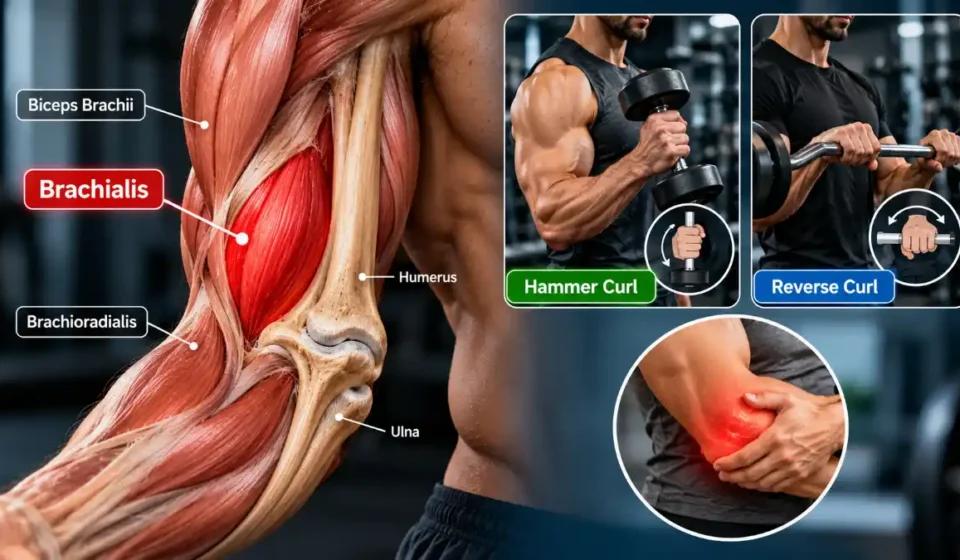

The brachialis muscle is a major elbow flexor located at the front of the upper arm, beneath the biceps brachii. It originates from the anterior surface of the humerus (upper arm bone) and attaches to the ulna, one of the two forearm bones. This arrangement allows the muscle to bend the elbow whether the forearm is pronated (palm down), supinated (palm up), or in a neutral position (thumb up).
The brachialis works alongside the biceps brachii and brachioradialis during everyday activities and resistance training. Unlike the biceps brachii, it does not significantly rotate the forearm. Understanding how these muscles differ can help you select suitable exercises and recognize when pain around the elbow or upper arm may need medical attention.
Brachialis Muscle Anatomy and Location
The brachialis sits in the anterior compartment of the upper arm, deep to the biceps brachii. It is one of the main muscles responsible for bending the elbow and contributes substantially to elbow-flexion strength.
Its key anatomical features include:
- Origin: Primarily the anterior surface of the distal half of the humerus.
- Insertion: The ulnar tuberosity and coronoid process of the ulna, near the elbow.
- Nerve supply: Mainly the musculocutaneous nerve, with the radial nerve supplying some fibers in certain individuals.
- Primary action: Elbow flexion.
Because the brachialis attaches to the ulna rather than the radius, it can flex the elbow effectively across different forearm positions. Its anatomy and function are described in detail in this medical overview of the brachialis muscle.
What Does the Brachialis Muscle Do?
The primary brachialis muscle function is elbow flexion, which brings the forearm toward the upper arm. You rely on it when lifting a bag, bringing food to your mouth, or performing a biceps curl.
The muscle helps bend the elbow whether your palm faces up, down, or inward. The biceps brachii also contributes to elbow flexion, but it has another important role: supination, or turning the palm upward. The brachialis does not meaningfully perform this rotational action.
Brachialis vs. Biceps Brachii vs. Brachioradialis
All three muscles contribute to elbow flexion, but they differ in location and secondary actions.
| Muscle | Main function | Key distinction |
| Brachialis | Elbow flexion | Works effectively across different forearm positions |
| Biceps brachii | Elbow flexion and forearm supination | Helps turn the palm upward |
| Brachioradialis | Elbow flexion | Particularly active when the forearm is in a neutral, thumb-up position |
These muscles work together rather than independently. Their contributions vary with the movement, forearm position, and resistance. You can learn more about the brachioradialis in this anatomical overview from StatPearls.
Brachialis Muscle Exercises
Exercises that involve bending the elbow against resistance recruit the brachialis along with other elbow flexors. Hammer curls and reverse curls are useful options, but neither completely isolates this muscle.
1. Hammer curls
Hold a dumbbell in each hand with your palms facing inward and thumbs pointing upward. Keep your elbows close to your sides as you bend them to raise the weights. Lower the dumbbells slowly, avoiding excessive torso movement or momentum.
The neutral grip engages the brachialis, biceps brachii, and brachioradialis. Use a weight that lets you maintain control throughout each repetition rather than swinging heavier dumbbells upward.
2. Reverse curls
Hold a barbell or a pair of dumbbells with your palms facing downward. Bend your elbows to lift the weight, keeping your wrists stable and upper arms relatively still. Then lower the weight under control.
The pronated grip changes how the elbow-flexor muscles contribute to the movement, while the brachialis continues to help bend the elbow.
Training tips
- Choose a resistance that allows controlled repetitions without excessive body swinging.
- Increase the weight gradually as your strength and technique improve.
- Work through a comfortable range of motion and avoid forcing the elbow through painful movements.
- Allow enough recovery between demanding training sessions.
- Stop an exercise if it causes sharp or worsening pain.
Progressive resistance training can improve elbow-flexion strength, but no particular grip or exercise guarantees superior brachialis growth.
Brachialis Muscle Pain: Causes, Symptoms, and Recovery
Pain around the brachialis can result from a muscle strain, overuse, or another condition affecting the elbow and surrounding tissues. Several muscles, tendons, nerves, and joint structures occupy this area, so the location of the pain alone cannot identify its cause.
Common symptoms and possible causes
A brachialis strain may cause pain or tenderness at the front of the upper arm, particularly near the elbow. Discomfort may become more noticeable when bending the elbow against resistance. Depending on the severity, symptoms can also include swelling, bruising, reduced strength, or restricted movement.
Possible triggers include lifting a heavy weight suddenly, repeating the same movement frequently, or increasing training intensity too quickly. However, similar symptoms can occur with other elbow conditions, including biceps tendon problems.
A distal biceps tendon injury may cause pain at the front of the elbow, sometimes accompanied by a popping sensation, bruising, or weakness when bending the elbow or turning the palm upward. These symptoms can overlap with other injuries, so they do not confirm a diagnosis on their own. The American Academy of Orthopaedic Surgeons’ guide to biceps tendon tears at the elbow explains common warning signs and how these injuries are assessed.
How to manage possible brachialis pain
For mild symptoms without signs of a significant injury, temporarily reduce activities that aggravate the area. Avoid heavy curls and other painful movements while symptoms settle, then return to exercise gradually as comfort and function improve.
General guidance for muscle strains and their symptoms can help you recognize when an injury may need medical attention. Seek assessment if pain persists, worsens, or interferes with normal activities.
Sudden severe pain, a popping sensation followed by bruising, substantial weakness, visible deformity, numbness, or difficulty moving the elbow warrants prompt medical evaluation. Do not assume that every instance of pain during elbow bending is a brachialis strain. A healthcare professional can examine the affected area and determine whether the problem involves the brachialis, a tendon, or another elbow structure.
Frequently Asked Questions
Is the brachialis muscle underneath the biceps?
Yes. The brachialis lies at the front of the upper arm, beneath the biceps brachii. Although it is less visible, it plays a major role in bending the elbow.
Which exercises work the brachialis muscle best?
Hammer curls and reverse curls are useful options because both recruit the brachialis along with other elbow flexors. Use controlled technique, increase resistance gradually, and choose exercises that do not cause pain. No single exercise completely isolates the brachialis.
How can you tell if your brachialis muscle is injured?
A strain may cause tenderness or pain at the front of the upper arm near the elbow, particularly during resisted elbow flexion. Swelling, bruising, weakness, or limited movement may also occur. These symptoms overlap with tendon and other elbow injuries, so persistent or significant pain should be assessed by a healthcare professional.