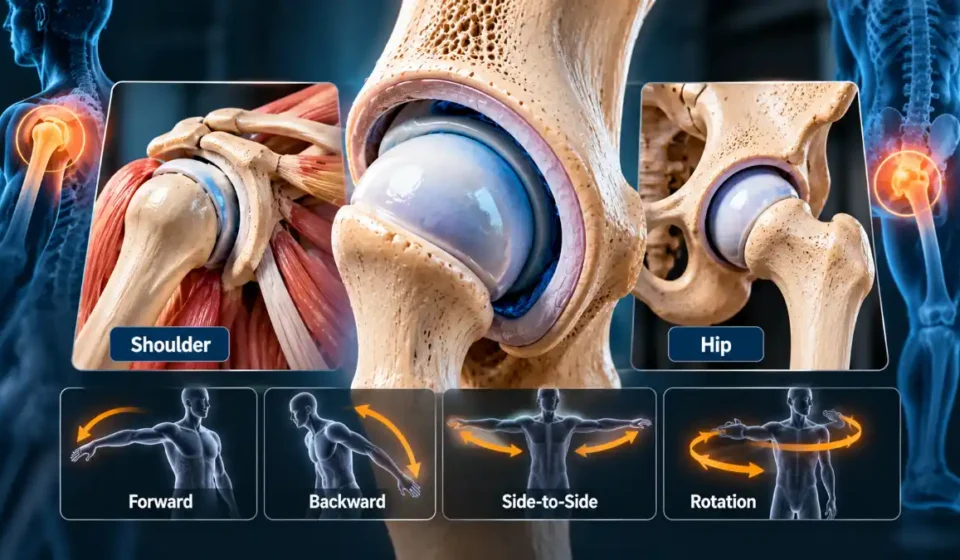

A ball joint, also called a ball-and-socket joint, is a type of synovial joint in which the rounded head of one bone fits into a socket in another bone. This arrangement allows movement in multiple directions, including bending, straightening, rotation, and circular motion. The shoulder and hip are the two main examples of ball-and-socket joints in the human body.
The shoulder joint allows extensive arm movement, making it possible to reach overhead, throw a ball, and rotate the arm. The hip joint combines mobility with greater structural stability, helping support body weight during standing, walking, and climbing stairs. Both joints share the same basic design, but their structures are adapted to different physical demands.
What Is a Ball-and-Socket Joint?
A ball-and-socket joint is a multiaxial synovial joint, meaning it allows movement around several axes. Its rounded bone surface moves within a socket, providing greater freedom of movement than joints that mainly bend and straighten in one direction.
In the shoulder, the head of the humerus, or upper arm bone, meets the glenoid cavity of the scapula, or shoulder blade. In the hip, the head of the femur, or thighbone, fits into the acetabulum, a deep socket in the pelvis. These structures form the two principal ball-and-socket joints in human anatomy.
Both joints have smooth, cartilage-covered surfaces and supporting tissues that help them move efficiently. Their design allows substantial movement while maintaining contact between the bones during everyday activities.
How Does a Ball Joint Work?
The rounded head moves within its socket as surrounding muscles contract and pull on the bones. This arrangement allows a limb to move in several directions rather than following a single path.
Articular cartilage reduces friction between the bone surfaces, while synovial fluid lubricates the joint. The joint capsule and ligaments provide passive support, while surrounding muscles and tendons help control movement and maintain stability.
What Movements Does a Ball Joint Allow?
One important feature of a ball-and-socket joint is its ability to produce several types of movement. These movements make everyday tasks possible, from reaching for an object on a high shelf to walking up a flight of stairs.
- Flexion: Decreases the angle between body parts. Bringing your thigh toward your torso involves hip flexion.
- Extension: Increases the angle between body parts or moves a limb backward from a flexed position. Moving your arm backward at the shoulder is one example.
- Abduction: Moves a limb away from the body’s midline. Raising your arm sideways away from your body is shoulder abduction.
- Adduction: Moves a limb toward the body’s midline. Bringing a raised arm back toward your side is shoulder adduction.
- Rotation: Turns a limb around its long axis. Turning your thigh inward or outward at the hip demonstrates rotation.
- Circumduction: Combines several movements to create a circular, cone-shaped path. Making circles with your arm at the shoulder is a familiar example.
The range of each movement depends on the joint’s structure and surrounding tissues. Both the shoulder and hip permit multidirectional movement, but the shoulder generally offers greater mobility, while the hip provides greater inherent stability.
What Are Examples of Ball-and-Socket Joints?
The shoulder and hip are the principal examples of ball-and-socket joints in the human body. Although their basic structure is similar, their socket shapes and supporting tissues influence how freely they move and how effectively they resist displacement.
The Shoulder Joint
The shoulder joint connects the head of the humerus with the glenoid cavity of the shoulder blade. Because the socket is relatively shallow, the joint permits extensive movement in different directions.
This design makes it possible to reach overhead, throw a ball, comb your hair, and move your arm across your body. However, the shoulder has less inherent bony stability than the hip. Its stability depends heavily on the joint capsule, ligaments, and surrounding muscles and tendons, including those of the rotator cuff.
The shoulder’s combination of mobility and muscular support allows a wide range of arm movements while helping keep the joint properly aligned.
The Hip Joint
The hip joint connects the head of the femur to the acetabulum of the pelvis. Its socket is deeper than the shoulder’s, and strong ligaments help reinforce the joint.
This structure helps the hip support body weight and maintain stability during standing, walking, running, and climbing stairs. The hip also allows flexion, extension, abduction, adduction, rotation, and circumduction, although its movement is generally more restricted than the shoulder’s.
The hip’s design is particularly important because it must accommodate movement while transferring forces between the upper body and the legs.
Shoulder vs. Hip Ball Joint: Key Differences
Both joints share the same basic ball-and-socket arrangement, but their anatomy reflects different functional priorities.
| Feature | Shoulder joint | Hip joint |
| Ball | Head of the humerus | Head of the femur |
| Socket | Glenoid cavity | Acetabulum |
| Socket depth | Relatively shallow | Relatively deep |
| Mobility | Greater range of motion | More restricted range of motion |
| Stability | Relies heavily on muscles and tendons for support | Benefits from a deeper socket, strong ligaments, and surrounding muscles |
| Main role | Arm movement and positioning | Weight-bearing and lower-body movement |
The key difference is the balance between mobility and stability. The shoulder prioritizes freedom of movement, while the hip is structured to provide greater stability under body weight. Both joints rely on several supporting structures to function properly.
What Keeps a Ball Joint Moving Smoothly and Stable?
Several structures work together to protect the joint surfaces, reduce friction, and control movement. The rounded bone head and socket establish the joint’s basic shape, but surrounding tissues are essential for normal function.
- Articular cartilage: This smooth tissue covers the ends of the bones inside the joint. It reduces friction and helps distribute forces across the joint surfaces.
- Joint capsule: This connective tissue enclosure surrounds the joint and helps maintain its structural integrity. Its inner lining, the synovial membrane, produces synovial fluid.
- Synovial fluid: This fluid lubricates the joint surfaces, helping them move smoothly against each other.
- Ligaments: These strong bands of connective tissue connect bone to bone. They help guide movement and resist excessive displacement.
- Surrounding muscles and tendons: Muscles generate the forces needed to move the limb, while tendons connect muscles to bones. Together, they provide active support and help control joint position.
These structures have complementary roles. Cartilage and synovial fluid support smooth movement, while the capsule, ligaments, and muscles help control the joint. The shoulder relies particularly heavily on muscular support because its socket is relatively shallow, whereas the hip benefits from a deeper socket and strong supporting ligaments.
Frequently Asked Questions
What is a ball joint in human anatomy?
A ball joint is a synovial joint in which the rounded head of one bone fits into a socket in another bone. This arrangement permits movement in several directions, including rotation.
What are examples of ball-and-socket joints in the human body?
The shoulder and hip are the two principal examples. The shoulder connects the humerus to the scapula, while the hip connects the femur to the pelvis.
What is the main function of a ball-and-socket joint?
Its main function is to allow multidirectional movement while maintaining joint stability. This enables activities such as reaching, rotating the arm, walking, and climbing stairs.
Why can the shoulder move more freely than the hip?
The shoulder has a relatively shallow socket that permits greater movement. The hip has a deeper socket and strong ligaments that provide greater stability for weight-bearing activities.
What movements can a ball-and-socket joint make?
It allows flexion, extension, abduction, adduction, rotation, and circumduction. The range of each movement depends on the joint’s structure and surrounding tissues.
What is the difference between a ball-and-socket joint and a hinge joint?
A ball-and-socket joint allows movement in several directions, including rotation. A hinge joint, such as the elbow’s main hinge articulation, primarily permits bending and straightening.
How do cartilage and synovial fluid help a ball joint?
Articular cartilage provides smooth surfaces over the bone ends, while synovial fluid lubricates those surfaces. Together, they help reduce friction during movement.
What keeps a ball-and-socket joint stable?
Joint shape, the capsule, ligaments, and surrounding muscles and tendons all contribute to stability. The relative importance of each structure differs between the shoulder and hip.

[…] and joints, including the ankle, hip, wrist, and shoulder. The hip and shoulder are examples of ball-and-socket joints, which allow movement in several […]