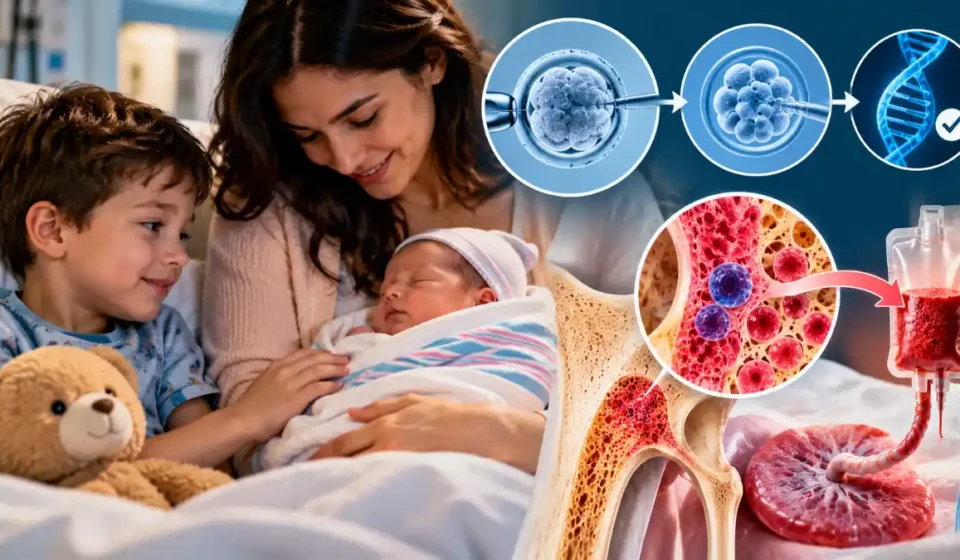

A bone marrow baby is an informal term for a child conceived through in vitro fertilization (IVF) and embryo testing so they may be able to donate compatible stem cells to a seriously ill sibling. The child is commonly called a savior sibling. This approach may help treat certain serious blood or immune disorders, although neither a suitable donor nor a successful transplant is guaranteed.
The baby is conceived through reproduction, not created directly from bone marrow cells. Doctors may use genetic testing to check for an inherited condition and human leukocyte antigen (HLA) tissue typing to assess compatibility with the affected sibling. If the child is born and is medically suitable, their umbilical cord blood or bone marrow may provide blood-forming stem cells for transplantation.
How Are Savior Siblings Conceived?
The process typically begins with IVF. Eggs are collected and fertilized with sperm in a laboratory, allowing embryos to develop before testing.
Doctors may use preimplantation genetic testing for monogenic conditions (PGT-M) to identify embryos affected by a specific inherited disorder. Separately, preimplantation tissue typing assesses whether an embryo may be compatible with the affected sibling. When appropriate, both approaches can be used together to identify embryos that meet the family’s medical requirements.
The tests serve different purposes:
- PGT-M: Checks for a specific inherited genetic condition.
- HLA tissue typing: Assesses tissue compatibility between the potential donor and the affected sibling.
A full biological sibling has approximately a 25% chance of being a complete HLA match. This figure describes the chance of a match, not the likelihood of a successful transplant. The overall process also depends on suitable embryos being available, testing results, IVF outcomes, donor suitability, and the recipient’s medical condition.
How Can a Bone Marrow Baby Help an Ill Sibling?
Blood-forming stem cells develop into red blood cells, white blood cells, and platelets. In a stem-cell transplant, compatible donor cells can help restore blood-cell production and, in some cases, immune function.
Two potential sources of stem cells are used in sibling donation:
- Umbilical cord blood: Collected from the umbilical cord and placenta after birth. It contains blood-forming stem cells that may be used for transplantation.
- Bone marrow: Collected from the donor through a medical procedure, generally under anesthesia.
Stem-cell transplants may treat certain serious conditions, including beta-thalassemia, Fanconi anemia, and selected inherited immune disorders. However, transplantation is appropriate only for certain patients after specialist evaluation. Suitability depends on the disease, donor compatibility, available stem-cell dose, and other clinical factors. The National Cancer Institute’s stem-cell transplant guidance explains how donor compatibility and transplant complications affect treatment.
Even with a compatible donor, a transplant may not succeed. Complications can include infection, graft-versus-host disease,e and failure of the transplanted cells to establish themselves. Doctors must assess the potential benefits and risks for both the donor and recipient.
What Medical and Ethical Issues Should Families Consider?
Conceiving a child to help an ill sibling raises important medical and ethical questions. Families need clear information about IVF, embryo testing, the likelihood of identifying a suitable embryo, and the possibility that transplantation may not succeed.
The potential donor child’s welfare is especially important. Cord blood collection after delivery differs from bone marrow donation later in childhood. Bone marrow collection involves medical risks, including those associated with anesthesia, and requires careful assessment and appropriate safeguards.
Parents and clinicians should consider the donor child’s safety, interests,s and future autonomy when making decisions. The child should be valued as an individual, regardless of whether they can donate stem cells or whether the transplant succeeds.
Access to embryo testing and tissue typing varies by country and clinical circumstances. In the United States, families should discuss medical eligibility, available testing and treatment options with qualified reproductive-medicine and transplant specialists. Regulations and clinical practices differ internationally.
Read also: Bone Marrow Baby
Frequently Asked Questions
Does a bone marrow baby always donate bone marrow?
No. Umbilical cord blood collected after birth may provide the stem cells needed for a transplant. Whether cord blood is sufficient or bone marrow donation is needed depends on the affected sibling’s condition and the transplant team’s assessment.
Does having a compatible sibling guarantee a successful transplant?
No. HLA compatibility can help doctors select a suitable donor, but it does not guarantee a cure. Outcomes depend on the underlying disease, the stem-cell source and dose, the recipient’s health, and possible complications.