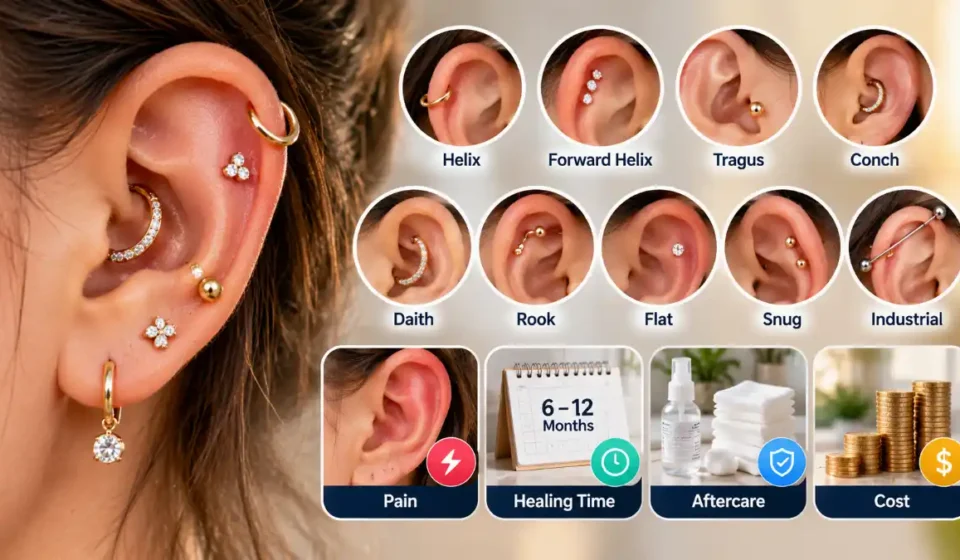

A cartilage piercing goes through the ear’s firm cartilage rather than the soft tissue of the earlobe. Popular placements include the helix, tragus, conch, daith, and rook. Most cartilage piercings take around 6–12 months to heal, sometimes longer. Pain varies from person to person, and choosing a skilled piercer, wearing properly fitted jewelry, and following good aftercare practices can help prevent complications.
Before deciding where to get pierced, think about your ear anatomy, sleeping habits, budget, and how much care you can manage during healing. A qualified piercer can help you choose a suitable placement and explain what to expect throughout recovery.
Types of Cartilage Piercings
Cartilage piercings get their names from where they’re positioned on the ear. Some placements are straightforward, while others require specific cartilage folds or enough space for the jewelry.
| Piercing Type | Location |
| Helix | Upper outer rim of the ear |
| Forward Helix | Front of the upper rim, near the face |
| Tragus | Small cartilage flap in front of the ear canal |
| Conch | Bowl-shaped central area of the ear |
| Daith | Inner cartilage fold above the ear canal |
| Rook | Raised inner cartilage ridge in the upper ear |
| Flat | Broad, flatter cartilage area of the upper ear |
| Snug | Inner cartilage ridge above the anti-tragus |
| Industrial | Two cartilage piercings connected by one barbell, usually across the upper ear |
Not every piercing suits every ear. Industrial and snug piercings, for example, depend heavily on individual anatomy. Even if you love a particular style, it’s worth having a professional check whether your ear can safely accommodate it.
Does a Cartilage Piercing Hurt?
Cartilage piercings often hurt more than standard earlobe piercings because the needle passes through firmer tissue. You may feel a quick, sharp pinch followed by pressure, tenderness, or throbbing.
Still, cartilage piercing pain is different for everyone. The placement, your sensitivity, and the piercing technique can all affect how uncomfortable it feels.
Some soreness is expected during the first few days, and the area may remain sensitive to pressure as it heals. Discomfort should generally improve over time. If pain becomes increasingly severe, especially with warmth or swelling, don’t dismiss it as normal healing.
What Happens During a Cartilage Piercing Appointment?
Your appointment usually starts with the piercer examining your ear and discussing placement. They’ll mark the proposed spot, check that the jewelry fits your anatomy, and prepare the area.
The actual piercing is performed using a sterile, single-use needle, followed by the insertion of appropriate starter jewelry.
Avoid piercing guns for cartilage. A professional using a sterile needle has better control over the placement and can avoid unnecessary tissue trauma.
Before booking, look for a studio that follows proper hygiene procedures. Fresh gloves, sterile needles opened in front of you, and correctly sterilized equipment and jewelry are essential. The professional piercing safety checklist provides additional guidance on evaluating a studio. You should also receive clear written aftercare instructions before leaving.
Cartilage Piercing Healing Time: What to Expect
Most cartilage piercings need approximately 6–12 months to heal completely, although some take longer depending on the location, your health, and how well the area is protected during recovery.
Unlike earlobes, cartilage has a more limited blood supply, which contributes to slower healing. The ear piercing healing guidance explains why different ear placements recover at different rates.
A piercing can look and feel healed while the tissue inside remains delicate. That’s why it’s important not to rush jewelry changes.
Common factors that can delay healing include:
- Sleeping directly on the pierced ear.
- Catching jewelry on hair, clothing, or accessories.
- Frequently touching or twisting the jewelry.
- Wearing jewelry that doesn’t fit properly.
- Repeated irritation or infection.
During healing, a piercer may recommend replacing the original longer post with a shorter one once swelling settles. This is called downsizing, and it helps prevent excess movement and snagging.
Avoid changing jewelry yourself until the piercing has fully healed, unless a qualified professional recommends an earlier adjustment.
Cartilage Piercing Aftercare: How to Clean and Protect It
Good cartilage piercing aftercare is mostly about keeping the area clean and avoiding unnecessary irritation. You don’t need complicated products or aggressive cleaning routines.
- Wash your hands thoroughly before touching or cleaning the piercing.
- Clean with sterile saline wound wash containing 0.9% sodium chloride, without added ingredients.
- Dry gently with clean, disposable gauze or another suitable disposable material.
- Don’t twist or rotate the jewelry. Moving it unnecessarily can irritate healing tissue.
- Keep pressure off your ear. Sleep on the opposite side or use a pillow with an opening that leaves the piercing undisturbed.
Be mindful of headphones, hair products, hats, and clothing that might rub against the jewelry. Avoid submerging a healing piercing in pools, lakes, oceans, or hot tubs, where contamination is possible.
Skip rubbing alcohol, hydrogen peroxide, harsh antiseptics, and homemade saltwater solutions. These can dry out or irritate the tissue and interfere with healing.
For more detailed cleaning recommendations, follow the professional body piercing aftercare guidelines.
Cartilage Piercing Infection, Bumps, and Complications
Some swelling, tenderness, minor bleeding, and light crusting are normal during early healing. However, changes that become worse rather than better deserve attention.
Possible cartilage piercing infection symptoms include:
- Pain that keeps increasing instead of improving.
- Spreading redness or unusual warmth.
- Significant or worsening swelling.
- Thick, pus-like discharge.
- Fever or feeling generally unwell.
Cartilage infections can be more serious than infections affecting the earlobe. One potential complication is perichondritis, an infection of the tissue surrounding the ear cartilage. Without appropriate treatment, it can damage cartilage and sometimes permanently change the ear’s shape.
If you suspect an infection, particularly when pain or swelling is worsening, seek medical attention promptly. You can learn more about perichondritis symptoms and complications. Don’t remove the jewelry without medical guidance, as doing so may complicate the situation.
Not every bump means infection. Small irritation bumps can develop from friction, pressure, or poorly fitted jewelry. Hypertrophic scars involve raised scar tissue near the piercing, while keloids may grow beyond the original wound. Metal sensitivity can also cause itching, redness, and irritation.
Because these problems have different causes, a persistent or worsening bump should be assessed rather than treated based on appearance alone.
Best Jewelry for a New Cartilage Piercing
The best starter jewelry combines a suitable material with the right size and shape for your piercing.
Implant-certified titanium that meets standards such as ASTM F136 is a popular option, particularly for people concerned about nickel sensitivity. Other suitable materials may include certain implant-grade steels, niobium, and solid 14k–18k gold that is nickel-free, cadmium-free, and appropriately alloyed for body jewelry.
The initial piercing jewelry standards explain which materials and specifications are appropriate for healing piercings.
Shape and fit matter just as much as material. Flat-back studs, curved barbells, straight barbells, and rings are used for different placements, but one style isn’t suitable for every piercing.
Jewelry that’s too tight may contribute to swelling or embedding. Excessively long jewelry can catch on clothing or move around too much. Your piercer should select a shape and size that accommodates initial swelling without creating unnecessary pressure.
How Much Does a Cartilage Piercing Cost?
In the United States, the price of a cartilage piercing varies by studio, location, placement, and jewelry choice.
Some studios advertise service fees of around $20–$45 for common cartilage placements, with jewelry charged separately. Others charge $50–$90 or more for the procedure, while some include basic starter jewelry in their quoted prices.
For example, published US piercing prices show service fees of approximately $85–$90 for several cartilage placements at certain studio locations, with jewelry costing extra.
These are individual studio examples, not a national average. More complicated placements and premium jewelry can increase the total considerably.
Before booking, ask whether the quoted price covers the procedure, starter jewelry, aftercare products, and any future downsizing appointment. Paying more for a clean studio and an experienced piercer is generally a better decision than choosing solely on price.
Read also: Cartilage Piercing
Frequently Asked Questions
Can a cartilage piercing close after years?
Yes. A cartilage piercing can shrink or close even after you’ve worn jewelry for years. How quickly this happens varies from person to person, and some openings tighten surprisingly fast. If your jewelry no longer fits easily, don’t force it through. A professional piercer can check whether the opening is still usable.
Can you get multiple cartilage piercings at once?
Yes, it’s possible to get more than one cartilage piercing during the same appointment. However, caring for several healing piercings can be challenging, especially if they’re on opposite ears and make sleeping uncomfortable. A qualified piercer can help you decide how many are reasonable based on your anatomy, placement choices, and ability to manage aftercare.