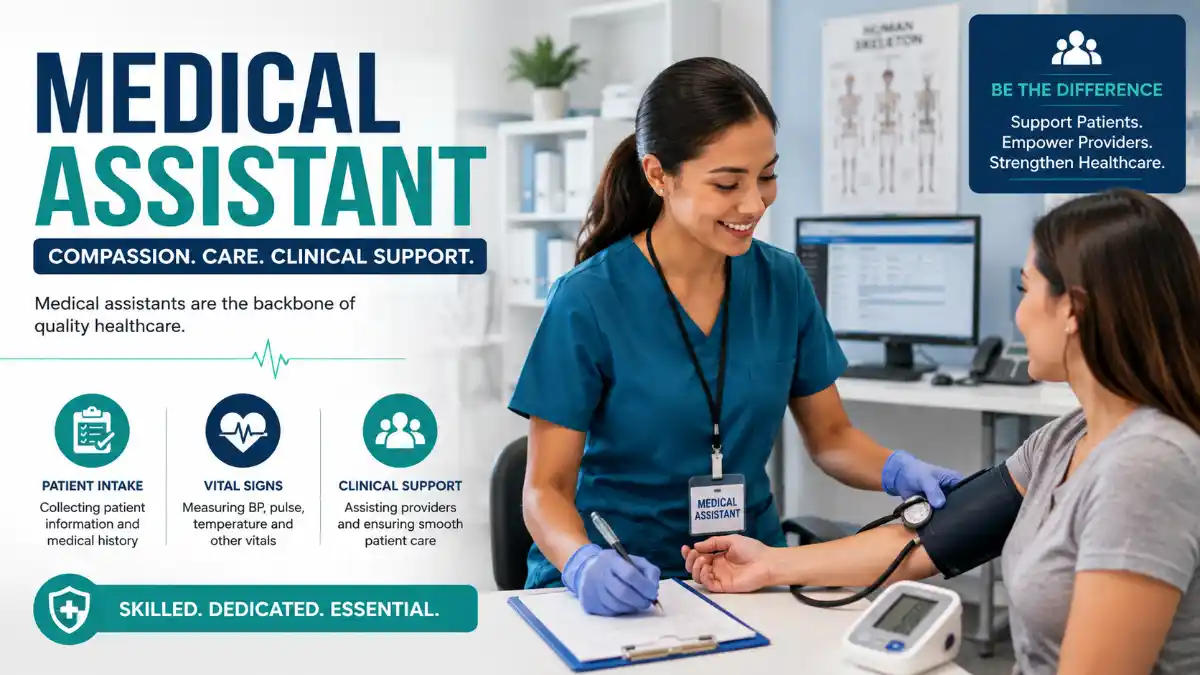

A medical assistant supports patients, clinicians, and day-to-day healthcare operations in outpatient settings. The role can combine clinical work, such as taking vital signs and preparing patients for examinations, with administrative work, such as scheduling appointments, updating records, and handling routine insurance or referral tasks. For someone exploring a healthcare career, medical assisting can offer patient contact without the education and licensure required for professions such as nursing or physician assistant.
What Is a Medical Assistant?
A medical assistant is an allied-health worker who supports licensed clinicians and the practice team. Medical assistants commonly work in physicians’ offices, outpatient clinics, specialty practices, hospitals, and other ambulatory healthcare settings. Their responsibilities can vary by specialty, employer, training, demonstrated competency, and state law.
The U.S. Bureau of Labor Statistics (BLS) describes medical assistants as workers who perform both administrative and clinical tasks. Typical duties include interviewing patients, recording medical histories, measuring vital signs, helping with examinations, scheduling appointments, maintaining medical records, collecting specimens, and managing supplies. BLS also notes that the exact duties vary by location, specialty, and employer.
A medical assistant is not a physician assistant. A physician assistant is a licensed medical professional who practices medicine in accordance with applicable state regulations. A medical assistant supports the care team and does not independently diagnose conditions, prescribe treatment, or create treatment plans.
Medical Assistant Duties: Clinical and Administrative Responsibilities
The biggest feature of the job is variety. A medical assistant may move from patient intake to documentation, from an examination room to the front desk, and from clinical support to follow-up coordination during the same shift.
Clinical Medical Assistant Duties
A clinical medical assistant works more directly with patients and supports the clinical side of an appointment. Depending on state law, training, employer policy, and appropriate delegation or supervision, duties may include:
- Measuring blood pressure, pulse, temperature, height, and weight
- Recording patient histories and documenting relevant information
- Preparing patients and examination rooms
- Preparing instruments and supplies for routine procedures
- Assisting a clinician during examinations
- Collecting and preparing specimens for laboratory testing
- Performing EKGs or ECGs when trained and authorized
- Supporting basic wound-care procedures when permitted
- Administering injections or medications when state rules and supervision requirements allow
- Cleaning, stocking, and maintaining clinical areas
- Entering clinical information into electronic health records
BLS specifically lists patient-history interviews, vital signs, examination assistance, specimen collection, medical-record updates, and injections or medications when directed and permitted by state law among common duties.
The important point is that a clinical medical assistant does not automatically have authority to perform every task learned in school. Scope-of-practice rules differ by state, and employers may impose additional requirements. Training, competency, delegation, and supervision can all affect what a medical assistant may legally and safely do.
Administrative Medical Assistant Duties
Administrative work keeps a practice organized and helps patients move through the healthcare system efficiently. Common responsibilities include:
- Greeting and checking in patients
- Scheduling, confirming, and rescheduling appointments
- Updating demographic and insurance information
- Maintaining electronic health records
- Answering phones and routing questions
- Coordinating referrals and follow-up visits
- Preparing forms and records for clinicians
- Supporting insurance verification, billing, coding, claims, or authorization workflows
- Communicating routine instructions approved by the care team
- Maintaining confidentiality and following privacy policies
- Ordering or restocking office and clinical supplies
Administrative medical assistant duties can look different in a primary-care office than in a specialty clinic. A dermatology practice, cardiology office, ophthalmology clinic, or urgent-care setting may emphasize different workflows and patient needs.
What Does a Medical Assistant Do in a Typical Day?
A medical assistant’s day usually follows the pace of the clinic rather than a fixed checklist.
Before appointments begin, the medical assistant may review the schedule, prepare examination rooms, check supplies, and make sure required records are available. During patient intake, the assistant may confirm identifying information, document the reason for the visit, update the history, and record vital signs.
Once the clinician begins the examination, the medical assistant may prepare equipment, assist with an office procedure, act as a chaperone when appropriate, or complete documentation required by the practice. After the visit, the assistant may help schedule follow-up care, coordinate a laboratory or imaging appointment, update the record, and prepare the room for the next patient.
This variety is one reason the career can appeal to people who like both patient interaction and practical organization. It also means the job can be physically and mentally busy. Medical assistants may spend part of the day standing or walking and another part working at a computer. BLS reports that most medical assistants work full time, with some working evenings, weekends, or holidays depending on the facility.
How to Become a Medical Assistant
If you want to become a medical assistant, start by identifying the employers and credential you are targeting. The best training route is not necessarily the shortest one; it is the route that gives you appropriate preparation and keeps you eligible for the certification you want.
1. Finish High School or an Equivalent Credential
Many training programs require a high school diploma or GED or equivalent. Helpful preparation can include biology, health science, mathematics, communication, and computer applications.
However, education requirements are not identical everywhere. BLS says medical assistants typically need postsecondary education such as a certificate, while some people enter the occupation with a high school diploma and receive on-the-job training.
2. Choose a Medical Assisting Program
Common education options include certificate, diploma, and associate-degree programs.
A certificate or diploma may be appropriate for someone who wants focused preparation for entry-level employment. An associate degree takes longer but may provide broader coursework and can fit students who want a college degree as part of their longer-term plan.
Training commonly covers:
- Anatomy and physiology
- Medical terminology
- Pharmacology fundamentals
- Clinical procedures
- Infection prevention and safety
- Medical law and ethics
- Patient communication
- Electronic health records
- Basic billing and coding
- Administrative procedures
- Supervised practicum or externship experience
BLS notes that medical assistant programs typically include supervised experience, such as a practicum.
3. Check Program Accreditation Before Enrolling
This step can prevent an expensive mistake. If you plan to pursue the CMA (AAMA) credential, confirm that the program meets the current eligibility pathway before paying tuition.
The American Association of Medical Assistants states that eligibility for the CMA (AAMA) Certification Exam includes graduation from a medical assisting program accredited by CAAHEP or ABHES, along with other specified eligibility pathways.
Do not assume that every program described as “medical assistant training” has the same accreditation status or leads to the same credential.
A practical comparison checklist includes:
| What to check | Why it matters |
| Programmatic accreditation | It can affect eligibility for specific certification pathways. |
| Total program cost | Tuition may not include books, uniforms, lab fees, exam costs, or other expenses. |
| Hands-on training | Supervised practice helps connect classroom knowledge with real workflows. |
| Credential eligibility | Confirm exactly which certification exams the program prepares you to pursue. |
| Completion outcomes | Ask the school for current, clearly defined outcome data. |
| Schedule | Evening, weekend, hybrid, or full-time formats may affect how quickly you can finish. |
Read More: Medical Assistant
4. Complete Supervised Hands-On Training
Classroom knowledge is only part of medical assisting. A good program should give students supervised opportunities to practice patient communication, clinical procedures, documentation, infection-control practices, and administrative workflows.
Hands-on training does not give a graduate unlimited authority. Once employed, the tasks a medical assistant performs remain subject to applicable law, employer policy, delegation, and competency requirements.
5. Decide Whether Certification Fits Your Goal
Certification is not a universal legal requirement for every medical assistant position, but some employers prefer or require a specific credential. Before choosing an exam, read current job postings in your target area and confirm the eligibility rules of the credentialing organization.
Medical Assistant Certification: CMA (AAMA), CCMA, and Other Credentials
The phrase “medical assistant certification” can refer to several different credentials. A school certificate and professional certification are not the same thing, and credentials from different organizations have different eligibility rules.
CMA (AAMA)®
The CMA (AAMA) credential is awarded by the Certifying Board of the American Association of Medical Assistants after candidates meet eligibility requirements and pass the CMA (AAMA) Certification Exam. One principal eligibility route is graduation from a CAAHEP- or ABHES-accredited medical assisting program; AAMA also lists other pathways.
The credential is not permanent. AAMA states that CMAs (AAMA) must recertify every 60 months. Recertification can be completed through continuing education or examination, subject to the organization’s current requirements.
CCMA
CCMA commonly refers to the Certified Clinical Medical Assistant credential offered by the National Healthcareer Association. Because eligibility, examination, fees, and renewal requirements can change, candidates should confirm the current requirements directly with the credentialing organization before enrolling in a program or scheduling an exam.
Certificate vs. Certification vs. License
These terms are easy to confuse:
- A training certificate shows that you completed an educational program.
- Professional certification shows that you met a certifying organization’s requirements and earned its credential.
- A license is government authorization to practice a regulated profession.
A medical assistant is generally an unlicensed healthcare worker, but that does not mean every task is allowed in every state. Certification does not replace state law, supervision, delegation, or employer requirements.
Medical Assistant Salary: What Can You Expect?
Medical assistant salary varies by geographic area, employer, specialty, experience, work setting, schedule, and benefits.
According to BLS, the median annual wage for medical assistants was $44,200 in May 2024, or $21.25 per hour. The median is not a guaranteed starting salary; it means half of workers earned more and half earned less. In the same data, the lowest 10% earned less than $35,020 and the highest 10% earned more than $57,830.
BLS also reports different median wages by major industry. In May 2024, the median was $47,560 in outpatient care centers, $45,930 in hospitals, $43,880 in physicians’ offices, and $37,510 in offices of other health practitioners.
When comparing medical assistant salary offers, look beyond the headline annual figure. Consider:
- Hourly rate
- Overtime eligibility
- Health insurance
- Retirement contributions
- Paid time off
- Holiday and weekend requirements
- Shift differentials
- Commute and parking costs
- Employer-paid training or certification
- Advancement opportunities
For a career decision, total compensation and working conditions can matter as much as the base wage.
Medical Assistant Job Outlook
The job outlook for medical assistants is currently stronger than the average projected growth across occupations. BLS projects 12% employment growth from 2024 to 2034 and about 112,300 openings per year, on average, during that period. BLS also projects employment to rise from about 811,000 jobs in 2024 to 912,200 in 2034.
These figures describe the U.S. occupation as a whole. They do not guarantee that an individual graduate will find a job quickly or earn a particular wage. Local demand can differ substantially by state, metropolitan area, specialty, and employer.
For someone entering healthcare, the outlook can be attractive because the occupation combines a relatively accessible education pathway with direct patient-care support and a broad range of outpatient employers.
Medical Assistant Work Settings and Specialties
Medical assistants can work in many environments, and the setting can change the day-to-day experience.
Common workplaces include:
- Primary-care practices
- Family medicine
- Pediatrics
- Dermatology
- Cardiology
- Orthopedics
- Women’s health
- Ophthalmology and optometry
- Urgent care
- Hospital-affiliated outpatient clinics
- Specialty medical offices
BLS reports that in 2024, physicians’ offices employed the largest share of medical assistants, followed by hospitals and outpatient care centers.
Specialization can also shape the skills you use. An ophthalmology practice may emphasize vision-related workflows, while a cardiology clinic may involve more EKG-related tasks. The job title may remain the same even when the practical responsibilities differ.
Read More: Medical Assistant
Medical Assistant Job Description: What Employers Look For
A medical assistant job description usually combines patient-service, clinical-support, documentation, and office responsibilities. The exact mix depends on the practice. A primary-care employer may expect a broader range of front-office and rooming duties, while a specialty clinic may emphasize a smaller set of procedures or workflow skills.
When reading a job description, look for the actual requirements rather than relying on the title alone. Pay attention to whether the employer asks for certification, prior experience, EHR proficiency, phlebotomy or EKG skills, bilingual communication, insurance knowledge, or specific scheduling responsibilities.
A useful job-description checklist includes:
- Required education or certification
- Clinical procedures expected on day one
- Administrative responsibilities
- EHR or practice-management systems
- Required experience
- Schedule and weekend expectations
- Physical requirements
- Benefits and advancement opportunities
This can help you compare a training program with the skills employers are actually requesting in your area.
Skills Needed to Succeed as a Medical Assistant
Technical knowledge matters, but strong interpersonal and organizational skills are equally important.
A successful medical assistant should be able to:
- Communicate clearly with patients and coworkers
- Protect confidential patient information
- Follow written and verbal procedures accurately
- Measure and document clinical information carefully
- Use electronic health records and office technology
- Manage competing tasks without losing attention to detail
- Stay calm when the clinic becomes busy
- Treat patients respectfully and professionally
- Recognize when a question or concern must be escalated to an appropriate clinician
- Work effectively as part of a healthcare team
The role is not simply “front desk plus basic clinical work.” Accuracy affects records, patient flow, safety, and communication, so small mistakes can have practical consequences.
Career Advancement After Medical Assisting
Medical assisting can be a long-term occupation or a starting point for broader healthcare development.
With experience, additional education, or employer-specific training, some professionals move into roles such as:
- Lead medical assistant
- Senior or specialty-clinic medical assistant
- Clinical coordinator
- Medical office supervisor
- Patient-care coordinator
- Referral specialist
- Prior-authorization specialist
- Billing and coding support
- Quality or population-health support
Others use medical assisting experience as preparation for a separate educational pathway in nursing, radiologic technology, sonography, health information, or physician assistant studies. Those are distinct careers with their own admissions standards, education, examinations, and licensing requirements.
Medical assisting can therefore be useful even when it is not someone’s final career destination. A medical assistant also gains a practical view of how patients, clinicians, records, and office systems connect.
Is Medical Assisting a Good Career for You?
Medical assisting may be a strong fit if you want regular patient interaction, structured clinical routines, and a role that combines hands-on and administrative responsibilities.
It may be less appealing if you want broad independent clinical authority, highly predictable desk work, or a job with little patient contact. The occupation requires boundaries: medical assistants support licensed clinicians rather than independently diagnosing or treating patients.
Before enrolling in a program, compare the actual job duties, local wages, certification expectations, commute, schedule, tuition, and advancement opportunities. That practical comparison is more useful than choosing a program based only on a generic promise of a “fast healthcare career.”
Frequently Asked Questions
What does a medical assistant do?
A medical assistant supports clinical and administrative workflow. Depending on the workplace, duties can include taking vital signs, documenting histories, preparing patients, assisting during examinations, scheduling appointments, updating records, coordinating referrals, and supporting billing or insurance workflows.
Can a medical assistant diagnose a patient?
No. A medical assistant does not independently diagnose medical conditions or create treatment plans. Those functions belong to appropriately licensed clinicians.
Can medical assistants give injections?
In some settings, medical assistants may administer injections or medications when applicable law permits the task, and the required delegation, supervision, training, and competency conditions are satisfied. The authority is not universal.
How long does it take to become a medical assistant?
The timeline depends on the program. Certificate and diploma programs can be shorter than associate-degree programs, while some people enter the occupation through on-the-job training. Check the specific school’s curriculum and the credentialing requirements you intend to follow.
Is a medical assistant certificate the same as certification?
No. A certificate generally shows completion of an educational program. Professional certification is a credential awarded by a certification organization after its requirements are met.
What is the difference between CMA (AAMA) and CCMA?
They are different professional credentials issued by different organizations. Their eligibility rules, examinations, and maintenance requirements are not identical. Check the current requirements and local employer preferences before choosing one.
Do medical assistants work in hospitals?
Yes. Medical assistants can work in hospitals and hospital-affiliated outpatient settings. Physicians’ offices and outpatient care centers are also major employment settings.
What skills do medical assistants need?
Important skills include patient communication, accurate documentation, vital-sign measurement, EHR use, infection prevention, organization, confidentiality, time management, and teamwork.
Is medical assisting a good career for career changers?
It can be a practical option for career changers who want a patient-facing healthcare role and are comfortable learning both clinical and administrative tasks. The right choice depends on local job opportunities, training cost, schedule, and long-term career goals.
Can medical assisting lead to nursing?
It can provide healthcare experience, but it does not replace nursing education or licensure. Becoming an LPN/LVN or RN requires a separate approved nursing education pathway and completion of applicable licensing requirements.



[…] is present in the index, middle, ring, and little fingers, as well as in the second through fifth toes. It is not present […]