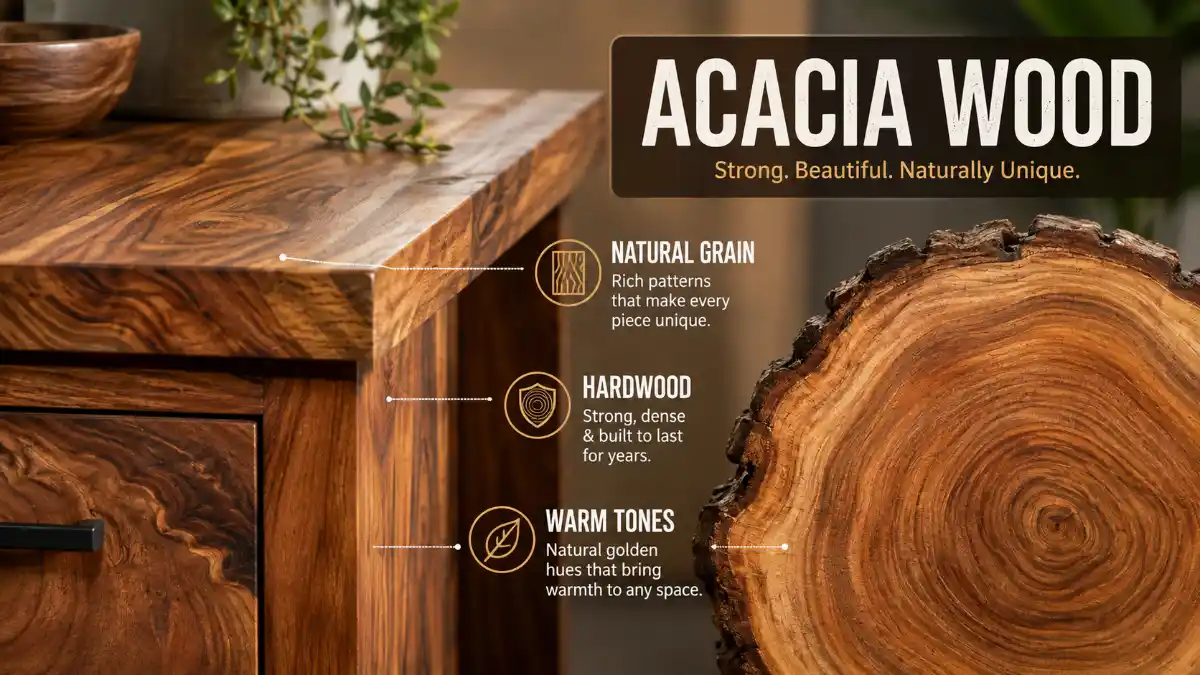

Acacia wood is popular for dining tables, benches, cutting boards, flooring, serving pieces, and outdoor furniture because it combines a distinctive grain with useful hardness and, in many species, good resistance to moisture and wear. But “acacia” is not a single standardized timber. Different species can behave quite differently, so the best buying decision depends on where the furniture will be used, how much maintenance you accept, and how the wood was finished.
This guide explains what acacia wood is, how durable it really is, where it works best, its main pros and cons, how to care for it, and how it compares with teak.
What Is Acacia Wood?
Acacia wood is timber sold under the common name “acacia,” which can refer to wood from multiple Acacia species and, in the marketplace, closely related or historically reclassified species as well. Examples associated with commercial wood products include Acacia mangium, Acacia koa, and Australian blackwood (Acacia melanoxylon). The species matter because density, hardness, grain, color, movement with moisture, and natural decay resistance are not identical across the group.
That variation is the first thing shoppers should understand: a label that only says “acacia” does not tell you every performance characteristic of the finished product. A solid Acacia mangium board, an Australian blackwood cabinet, and Hawaiian koa furniture can have very different appearances and properties.
The USDA Forest Products Laboratory has also documented measurable dimensional movement in commercial Acacia mangium and Acacia confusa flooring as moisture conditions change. In practical terms, acacia is still wood: changes in humidity can cause it to expand and contract, so good drying, construction, finishing, and indoor climate control matter.
What Does Acacia Wood Look and Feel Like?
Acacia is best known for visual variation. Depending on the species and board, colors can range from pale golden or yellow-brown to richer reddish and medium-brown tones. Grain may be straight, wavy, interlocked, or irregular, which gives many acacia furniture pieces a more dramatic appearance than uniform-grained woods.
The texture and weight also vary by species. For example, the Wood Database lists Acacia mangium at about 36.5 pounds per cubic foot when dried and gives it a Janka hardness rating of 1,430 lbf. That is a useful reminder that there is no single hardness number that accurately represents every product sold as acacia wood.
Is Acacia Wood Hard?
Yes, many acacia species used in furniture are reasonably hard and suitable for surfaces that receive everyday wear. Janka hardness measures resistance to indentation, so it is useful for comparing how easily a wood may dent. It does not, however, measure every aspect of durability, such as resistance to rot, moisture movement, UV exposure, or poor construction.
That distinction matters when evaluating acacia wood furniture. A hard tabletop can still develop surface checks or movement if it is exposed to repeated moisture changes or harsh outdoor conditions.
Acacia Wood Durability: How Long Does It Last?
Acacia wood durability is good for many indoor applications, but it should not be reduced to one universal lifespan. Species, board quality, moisture content, joinery, finish, location, and maintenance all affect service life.
For indoor furniture, well-made acacia can be a long-term material. Dining tables, benches, cabinets, coffee tables, and other frequently used pieces can handle normal household wear when the finish is maintained, and spills are dealt with promptly.
Outdoor use requires more caution. Acacia can perform well outside when the furniture is designed for outdoor use and receives appropriate protection, but untreated exposure to strong sun, repeated wetting, and drying can accelerate fading, surface checking, and dimensional movement. The fact that a wood is hard does not automatically make it decay-proof.
Wood durability is also different from hardness. Durability refers to resistance to biological deterioration such as decay and insects, while hardness primarily describes resistance to indentation. The distinction is important when choosing acacia wood outdoor furniture.
Is Acacia Wood Waterproof?
No. Acacia is not waterproof. A suitable finish can slow water penetration, and some species have useful natural resistance, but prolonged moisture, standing water, repeated wetting and drying, or poor drainage can still damage wood.
For an outdoor table, for example, a finish and a breathable cover can reduce exposure, but neither turns the tabletop into a waterproof material. Good design and maintenance remain important.
Acacia Wood Uses: Where Does It Work Best?
Acacia wood uses extend well beyond a single furniture category. Its combination of appearance, workable strength, and availability makes it suitable for many household products.
Common uses include:
- Acacia wood furniture: dining tables, coffee tables, benches, chairs, stools, cabinets, and shelving.
- Outdoor furniture: patio tables, benches, chairs, and other pieces made and finished for exterior use.
- Flooring: solid and engineered flooring products, where species-specific hardness and dimensional behavior are considered.
- Kitchenware: cutting boards, serving boards, bowls, and utensils, provided the product is properly finished and intended for food contact.
- Decorative products: bowls, trays, frames, turned objects, and other household décor.
- Specialty wood products: selected acacia species are also used for musical instruments, cabinetry, and other higher-value applications.
The important point is that “acacia” describes a broad commercial category. Always check the species, construction, finish, and intended use rather than assuming every acacia product will perform the same way.
Acacia Wood Furniture: Is It a Good Choice?
Acacia wood furniture is a strong option when you want visible natural grain, a substantial feel, and a surface that can handle everyday household use.
For a dining table, acacia can be especially practical because small scratches and changes in tone may blend into a naturally varied grain better than they would on a very uniform surface. That does not mean it is scratch-proof. Coasters, placemats, cutting boards, and sensible cleaning habits still help preserve the finish.
For cabinets, benches, and accent tables, appearance may be as important as hardness. Here, the species and finish become particularly important because two products marketed as acacia may have noticeably different colors and textures.
When shopping, ask four questions:
- Is the product solid wood, veneer, or a combination?
- Which acacia species is used, if the seller provides that information?
- What finish was applied?
- Is the piece specifically rated or designed for outdoor use?
Those answers tell you more about expected performance than the word “acacia” alone.
Acacia Wood Pros and Cons
The main acacia wood pros and cons are easier to understand when durability, appearance, maintenance, and value are considered together.
| Pros | Cons |
| Attractive natural color and varied grain | Performance varies substantially by species and product |
| Good hardness for many everyday furniture applications | Not waterproof |
| Suitable for many indoor furniture and household uses | Outdoor exposure can cause fading, checking, and movement |
| Can offer good value compared with premium outdoor woods | Outdoor pieces need more care than very weather-resistant woods such as teak |
| Available in several species with different visual and working characteristics | Heavy or substantial pieces can be difficult to move |
| Can develop a natural aged appearance outdoors | Finish quality and construction strongly affect performance |
Read More: Acacia Wood
One of the biggest advantages is visual character. One of the biggest disadvantages is also variation: buyers cannot assume that every product carrying the acacia label has the same density, hardness, or decay resistance.
Acacia Wood for Indoor vs. Outdoor Furniture
Acacia wood is generally easier to manage indoors because indoor furniture is protected from direct rain and extreme outdoor exposure. Normal cleaning, sensible humidity control, and care of the surface finish are usually more important than frequent weatherproofing.
Outdoor acacia wood furniture is different. It should ideally be placed where water can drain away and where constant direct sun is limited. A cover can help, but it should be used in a way that does not trap moisture against the wood.
When Acacia Is a Good Outdoor Choice
Choose acacia wood outdoor furniture when you want a natural hardwood look and are comfortable with periodic cleaning, finish maintenance, and some weathering.
It is particularly sensible for covered patios, balconies, porches, and outdoor areas where furniture can be protected from the harshest exposure. It can also work in more exposed settings if the product is properly constructed and maintained, but expectations should be realistic.
When Teak Makes More Sense
Teak is the stronger choice when the main priority is long-term outdoor durability with relatively low maintenance. Genuine teak is widely recognized for high natural decay resistance, and its heartwood is considered very durable. Its Janka hardness is about 1,070 lbf, showing why hardness alone cannot be used as a proxy for outdoor durability.
Acacia can make more sense when the budget is tighter or when the furniture will be protected and maintained. The better material depends on the environment, not simply on which wood has the higher hardness number.
Acacia Wood vs. Teak
Acacia wood vs. teak is not really a contest between “good” and “bad” wood. They are strong choices for different priorities.
| Factor | Acacia | Teak |
| Appearance | Often varied, warm, and highly grained | Typically golden to medium brown with a naturally oily feel |
| Hardness | Varies significantly by species | About 1,070 lbf for teak |
| Outdoor durability | Can be good with suitable design and maintenance; varies by species | Excellent natural decay resistance, especially in heartwood |
| Maintenance outdoors | Usually more involved | Generally lower maintenance |
| Weathering | Can fade, gray, check, or move with exposure | Can weather to a silvery patina while retaining strong decay resistance |
| Typical buying advantage | Often attractive for value and visual variety | Strong choice when outdoor longevity is the priority |
Read More: Acacia Wood
Teak should not be chosen simply because it is harder. In fact, the listed Janka values show some acacia species can be harder than teak. Teak’s advantage outdoors comes from its natural durability and weathering performance, not from maximum hardness alone.
How to Care for Acacia Wood
Acacia wood care is straightforward when you match the routine to the product’s finish and location.
For indoor pieces:
- Dust with a soft cloth and remove grit that could scratch the finish.
- Wipe spills rather than allowing water to sit on the surface.
- Use the cleaner recommended by the manufacturer for the existing finish.
- Avoid placing furniture immediately beside intense heat sources.
- Do not automatically oil a finished surface unless the manufacturer recommends it. Some finishes are designed to be cleaned and periodically refreshed rather than repeatedly oiled.
For outdoor pieces:
- Follow the manufacturer’s cleaning and refinishing instructions.
- Keep standing water from collecting on horizontal surfaces.
- Use a suitable exterior finish when the product calls for one.
- Protect furniture from prolonged severe exposure when practical.
- Allow the wood to dry properly after wet conditions.
- If the surface develops weathering, clean it gently before deciding whether it needs refinishing.
The right maintenance depends on the finish. A factory-coated table, an oil-finished bench, and an unfinished piece should not all receive the same treatment.
Does Acacia Wood Need Oil?
Not necessarily. Oiling is a finishing choice, not a universal requirement. Some outdoor products are designed to be oiled periodically, while other finishes are intended to weather naturally or be maintained with a specific coating.
Before applying teak oil, mineral oil, or another product, identify the existing finish and check the manufacturer’s instructions. Using an incompatible treatment can change the appearance or interfere with the finish.
Does Acacia Wood Crack or Warp?
It can. Like other natural wood, acacia responds to changes in moisture content. Research from the USDA Forest Products Laboratory has measured dimensional change in Acacia mangium flooring under changing moisture conditions. That does not mean a properly made table will automatically warp; it means wood movement is a normal material behavior that good design and stable conditions help control.
Cracking or warping becomes more likely when wood is poorly dried, exposed to severe moisture swings, left in harsh weather, or constructed without allowing for normal movement. Indoor pieces should be kept in a reasonably stable environment, while outdoor pieces need construction and finishing appropriate to exterior conditions.
Is Acacia Wood Eco-Friendly?
Acacia should not automatically be labeled “eco-friendly” simply because it grows quickly. Sustainability depends on the species, plantation or forest management, land-use history, harvesting practices, transportation, product lifespan, and whether responsible sourcing can be verified.
Acacia mangium, for example, is grown in plantations in several regions and has been studied by the U.S. Forest Service and other researchers. Plantation growth can support renewable wood supply, but that fact alone does not prove that a particular product was responsibly sourced.
If sustainability is important to you, look for clear information about species, origin, responsible forestry, and credible certification rather than relying only on the word “acacia.”
How to Choose Acacia Wood Furniture
The best acacia wood furniture is not necessarily the piece with the most dramatic grain or the lowest price. Look at the whole product.
Check the construction. Solid wood, engineered wood with acacia veneer, and mixed-material furniture have different characteristics and price points.
Inspect the surface. Look for an even finish, clean joinery, stable legs, and no obvious splits or poorly repaired defects.
Ask about the finish. This is especially important for outdoor furniture. A suitable exterior finish and clear maintenance instructions are valuable.
Match the furniture to the environment. Indoor furniture has different requirements from exposed patio furniture.
Consider maintenance before buying. If you want outdoor furniture that can sit uncovered for long periods with little attention, teak may fit better. If you are comfortable with periodic care and want acacia’s appearance and value, acacia can be a very practical choice.
Frequently Asked Questions
Is acacia wood good quality?
It can be. Acacia is a broad category rather than one uniform timber, so quality depends on species, board selection, drying, construction, and finish. A well-made acacia product can be durable and attractive, while a poorly made product can fail regardless of the species name.
Is acacia wood waterproof?
No. Acacia can have useful moisture resistance, but it remains a porous natural wood. Finishes can reduce water penetration, but prolonged wetting and standing water can still cause problems.
How durable is acacia wood?
Acacia wood durability is generally good for many indoor furniture applications, but outdoor performance varies by species, construction, finish, climate, and maintenance. Hardness and decay resistance are separate properties.
Is acacia wood good for outdoor furniture?
Yes, when the furniture is designed for outdoor use and maintained appropriately. It is a reasonable choice for protected patios and similar spaces, but fully exposed furniture requires more attention than naturally highly durable woods such as teak.
Does acacia wood furniture need to be sealed?
Not every piece does. Outdoor furniture may benefit from an appropriate exterior sealer or finish, while the correct treatment for indoor furniture depends on its existing finish. Follow the manufacturer’s care instructions.
Does acacia wood turn gray?
It can. Exterior wood exposed to sunlight and weather can gradually lose its original color and develop a gray or silver appearance. Gray weathering is primarily a surface-color change, although severe exposure can also contribute to checking and other deterioration.
Is acacia wood better than teak?
Neither is universally better. Teak has a major advantage in natural outdoor durability and low-maintenance weathering. Acacia can offer attractive grain, good hardness, and value, particularly when the furniture is protected and maintained.
Is acacia wood good for a dining table?
Yes. A well-constructed acacia dining table can be a strong everyday choice because many acacia species provide a hard, attractive surface. The finish and construction matter just as much as the species label.
How should I clean acacia wood furniture?
Use a soft cloth for routine dusting and wipe spills promptly. For deeper cleaning, follow the manufacturer’s instructions for the specific finish. Avoid harsh cleaners or treatments that can damage the coating or alter the wood.
Is acacia wood sustainable?
It can be responsibly sourced, but the species name alone does not establish sustainability. Check the product’s sourcing information, forestry practices, origin, and credible certification when those factors matter to your purchase.



[…] enter a ZIP code or city. The location system is designed to return nearby stores, while individual store pages provide hours, phone numbers, directions, and the brands or departments available at that […]