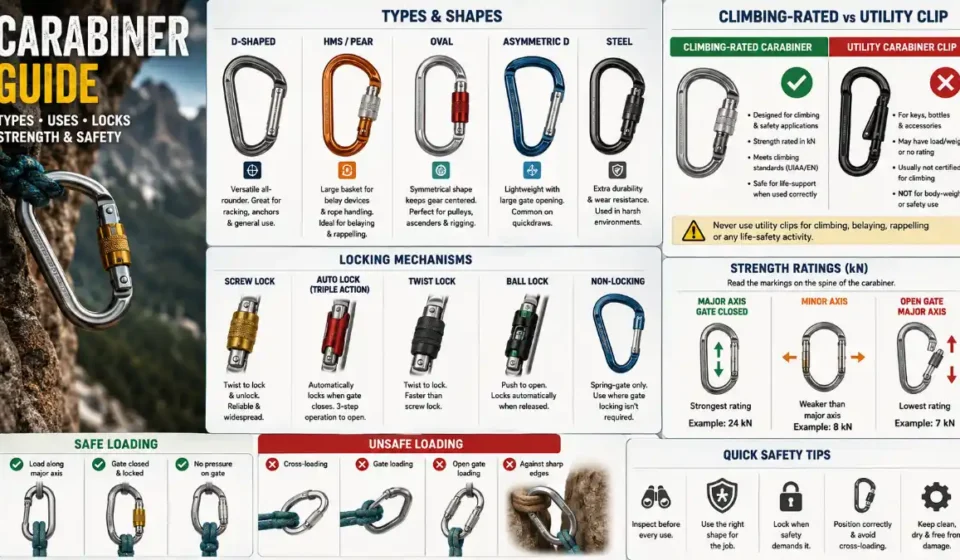

A carabiner is a spring-gated connector used to join components in climbing, mountaineering, and gear systems. The key distinction is whether the connector is certified for life-safety use or intended only for everyday carrying. A climbing-rated carabiner is designed, tested, marked, and used within defined limits; a utility carabiner clip or keychain hook may look similar but should not be treated as climbing hardware.
That difference matters. Before using any connector for belaying, rappelling, anchors, or other life-safety applications, verify its intended use, strength markings, applicable certification, and the manufacturer’s instructions.
What Is a Carabiner?
A carabiner, also called a karabiner, is a connector with a hinged gate that opens to allow equipment to be clipped in. Climbing versions are commonly made from aluminum alloys for low weight or steel for applications where durability and wear resistance are priorities.
The main components are the frame, spine, basket, gate, nose, hinge, and, on locking models, a locking sleeve or mechanism. The frame provides the structural path for the load, while the gate allows equipment to enter and exit the connector.
In climbing, the connector is only one part of a larger safety system. Its strength depends on how it is oriented, loaded, and combined with rope, slings, protection, anchors, harnesses, or other equipment. A strong connector can still be dangerously loaded if it is cross-loaded, forced against an edge, held open, or used outside its intended application.
Carabiner Clip vs Climbing Carabiner
“Carabiner clip” is a broad retail term. It can describe certified climbing equipment, but it is also commonly used for keychain hooks, bottle clips, backpack accessories, and organizers.
Appearance is not proof of climbing suitability. For life-safety use, look for equipment specifically intended for climbing or mountaineering and check its markings and certification information. UIAA 121 covers connectors for climbing and mountaineering, while EN 12275 is the corresponding European connector standard referenced by UIAA.
| Feature | Climbing-rated connector | Utility carabiner clip |
| Primary purpose | Climbing and other specified safety applications | Keys, bottles, accessories, and light gear |
| Strength markings | Typically given in kN for defined loading directions | May show a carrying capacity or no meaningful strength rating |
| Certification | May comply with applicable climbing standards | Usually not certified for climbing |
| Body-weight use | Only when specifically designed and certified for the application | No |
| Examples | Locking HMS, quickdraw connector, anchor connector | Keychain clip, bottle clip, backpack hook |
Read More: Carabiner
A carabiner keychain should not be used for climbing, belaying, rappelling, rescue, fall protection, or body-weight support unless the product is explicitly certified and intended for that specific life-safety application. A stated carrying capacity on a utility clip is not equivalent to a climbing strength rating.
Carabiner Types by Shape
Shape affects how the connector handles rope, protection, belay devices, and anchors. The best design depends on the task rather than on a single universal strength or size.
D-Shaped and Asymmetric D Designs
D-shaped connectors direct much of the load toward the spine. Asymmetric D models are especially common because they combine a useful gate opening with efficient loading and relatively low weight.
These designs are widely used for gear racking, protection, quickdraws, and general climbing connections. Locking versions can also be useful for anchors or other applications where a secure gate is required.
Pear-Shaped or HMS
HMS connectors have a broad, rounded basket that provides room for a belay device and rope. Locking HMS designs are common for belaying and are also used in some rope-management and anchor applications.
HMS describes the shape and intended function; it does not by itself mean that the connector is automatically locking. Always check the actual product design and manufacturer instructions.
Oval
Oval connectors have a relatively symmetrical shape that can help equipment remain centered. They are useful in some aid-climbing applications, pulley setups, and gear-organization tasks where predictable alignment is valuable.
They are not automatically the best choice for general climbing. Choose them when their geometry suits the equipment and loading pattern.
Steel
Steel connectors are heavier than aluminum models but can be advantageous in high-wear environments. They are used in some fixed anchors, climbing-wall systems, work-at-height equipment, and rescue applications when the product is specifically designed and certified for that role.
For a personal climbing rack, aluminum is often preferred because reducing carried weight matters. Material alone, however, does not determine suitability; certification, design, and intended use are more important.
Locking and Non-Locking Carabiners
Gate design is one of the main differences between connector types. Non-locking models use spring tension to return the gate toward the closed position. Locking models add a mechanism intended to reduce the chance of unintended gate opening.
A locking mechanism does not compensate for poor loading or incorrect setup. The connector still needs to be correctly oriented, compatible with the equipment, and fully closed and locked when the application requires it.
Non-Locking
Non-locking models are common in quickdraws and gear racking because fast clipping is important. They can use straight gates, bent gates, or wire gates.
A non-locking connector is not inherently inappropriate for climbing. It is a normal part of systems designed around non-locking connections, such as many quickdraws.
Screwgate
A screwgate uses a manually operated threaded sleeve. After the gate closes, the sleeve is turned into position to prevent the gate from opening.
Its simple mechanism makes the locking state easy to understand and inspect. The user still needs to confirm that the sleeve is correctly positioned and that dirt, ice, damage, or wear has not affected operation.
Auto-Locking
Auto-locking designs use mechanisms such as twist-lock or other multi-action systems that return to a locked state after the gate closes, depending on the model.
They can reduce reliance on remembering to screw a sleeve closed, but they still require a deliberate function check. Users should know exactly how the mechanism opens, closes, and relocks before relying on it.
Wiregate
A wiregate uses a wire rather than a solid gate. This can reduce weight and gate mass, which is useful in quickdraws and alpine systems.
Wiregates are common in sport, trad, and alpine climbing. Many models use a shaped nose that helps control snagging and gate engagement. The exact nose design varies by manufacturer.
Straight-Gate, Bent-Gate, and Keylock
Straight-gate designs are common on the protection end of quickdraws, while bent-gate designs are often used on the rope end because the gate geometry can make rope clipping easier.
A keylock nose is a smooth nose-and-gate interface designed to reduce snagging. “Keylock” does not mean that the gate locks; it describes the nose design.
Common Carabiner Uses
Carabiner uses range from critical climbing connections to simple gear organization. The correct choice depends on the consequences of failure.
Belaying and Rappelling
Belaying and rappelling require life-safety equipment selected for the specific system. A large locking HMS connector is commonly paired with compatible belay devices because its broad basket provides room for the device and rope.
Compatibility matters. Follow the belay-device and connector manufacturer’s instructions, confirm that the gate is closed and locked when required, and make sure the connector is positioned as intended.
Anchors
Locking connectors are commonly used in many anchor systems, although the exact configuration depends on the anchor design. The connector should be selected for the expected loading and arranged so that it is not unnecessarily cross-loaded, levered against an edge, or forced open.
Anchor construction is a technical climbing skill. Use established procedures and appropriate instruction rather than treating a connector as a standalone safety device.
Quickdraws
A quickdraw normally consists of two non-locking connectors joined by a sewn sling. One end clips to protection, such as a bolt hanger, and the other is intended for the rope.
The two ends may use different gate styles. The rope-end connector is often shaped for efficient clipping, while the protection end may prioritize stable attachment. Correct orientation and clipping technique are part of safe quickdraw use.
Trad Gear Racking
Trad climbers commonly rack cams, nuts, slings, and other protection on lightweight connectors. D-shaped and asymmetric D designs are popular because they provide practical gate clearance and efficient gear organization.
Racking connectors should still be climbing-rated when they are part of the climbing system. Color coding can improve organization, but color has no bearing on strength or certification.
Hiking and Backpack Organization
For hiking, a utility clip can be useful for attaching light accessories such as bottles, gloves, sandals, or small organizers. This is a carrying function rather than a life-safety application.
Do not use an accessory clip to suspend a person, support body weight, or replace hardware specifically rated for climbing, rescue, fall protection, or other safety-critical systems.
Keychains and Everyday Carry
A carabiner keychain is convenient for keys, small tools, flashlights, and travel accessories. These products can be practical because they are quick to attach and easy to organize.
The important limitation is simple: everyday convenience does not establish structural safety. Unless a product is explicitly certified and intended for a life-safety application, treat it as an accessory clip.
Read More: Carabiner
How to Read a Carabiner Weight Rating
The term “carabiner weight rating” can be confusing. Climbing connectors are generally marked with strength values in kilonewtons (kN), which describe force rather than a simple maximum person weight.
Typical markings identify strength for different loading conditions, including the major axis with the gate closed, the minor axis, and the major axis with the gate open. The values are not interchangeable.
For example, a connector might be marked 24 kN, 8 kN, and 7 kN. Those figures describe tested strength in specified configurations; they are not instructions to convert the largest number directly into a safe body-weight limit.
Major-Axis Strength
The major axis is the primary lengthwise loading direction of the frame. It is generally the preferred direction for a connector intended to carry a climbing load.
Keep the connector aligned with the intended load path and avoid setups that allow it to rotate into a weaker orientation.
Minor-Axis or Cross-Loading
Minor-axis loading occurs when the force is applied across the frame rather than along its strongest loading direction. This can significantly reduce strength.
Cross-loading can occur when a connector shifts against a harness loop, anchor component, sling, bolt hanger, or another piece of hardware. A locking gate does not eliminate the structural consequences of incorrect loading.
Open-Gate Strength
An open gate changes the way the frame carries force and results in lower strength than the intended closed-gate configuration. The gate can be held open by contact with rock, hardware, another connector, or poor geometry.
UIAA guidance emphasizes the importance of the open-gate strength marking and specifies minimum strength requirements for certified connector types.
How to Choose the Right Carabiner
Choose by application first, then shape, gate design, size, weight, and handling.
- Decide whether the job is life-safety or utility. For climbing, rappelling, belaying, anchors, or body-weight support, use equipment specifically certified and intended for the application.
- Select the shape for the task. HMS designs suit many belay systems; D and asymmetric D designs are versatile for many climbing connections; oval designs are useful where symmetry and alignment matter.
- Choose the gate type. Non-locking connectors are common in quickdraws and gear racks. Locking models are common where accidental gate opening would have serious consequences.
- Check compatibility. The connector must work correctly with the rope, belay device, harness attachment point, protection, sling, or anchor component.
- Read the markings. Check strength values and any relevant standard or certification markings. Do not rely on appearance or a generic product description.
- Consider handling. Gate opening, locking operation, weight, size, and ease of clipping all affect practical use.
- Inspect before use. Look for cracks, deformation, excessive wear, corrosion, gate problems, and locking-mechanism faults.
Inspection, Maintenance, and Retirement
Inspect climbing connectors before use and pay particular attention after unusual loading, impact, contamination, or exposure to conditions that could cause damage.
Check the frame for cracks, sharp gouges, deformation, heavy wear, or corrosion. Operate the gate and locking mechanism to confirm smooth movement and complete closure. Examine the nose, hinge, rivets, and sleeve for damage.
Retirement is appropriate when the connector is damaged, deformed, cracked, deeply worn, badly corroded, exposed to damaging heat or chemicals, or no longer closes and locks correctly. Manufacturer retirement guidance should take precedence because service life and inspection criteria can differ between products.
If you cannot confidently establish that a safety connector remains fit for use, remove it from life-safety service rather than taking a chance.
Read More: Carabiner
Carabiner Safety Mistakes to Avoid
Several common mistakes are easy to prevent:
- Using a keychain clip for climbing because it looks strong.
- Treating a printed weight capacity as equivalent to a climbing strength rating.
- Assuming a locking mechanism makes every loading direction safe.
- Allowing the connector to become cross-loaded.
- Letting the gate contact rock, hardware, or another object in a way that can hold it open.
- Mixing components without checking compatibility.
- Continuing to use hardware after significant deformation, corrosion, or other damage.
- Choosing equipment by color or appearance instead of intended use and certification.
The central rule is straightforward: use certified equipment for life-safety applications, follow the manufacturer’s instructions, and keep the connector loaded in its intended configuration.
Frequently Asked Questions
What is a carabiner used for?
A climbing connector joins components such as rope systems, harnesses, slings, protection, and belay equipment. Utility clips are commonly used for keys, bottles, and lightweight accessories.
Are all carabiners safe for climbing?
No. Only equipment specifically intended and appropriately certified for climbing, or the relevant safety application, should be used for life-safety purposes. A utility clip or keychain hook is not a substitute.
What does kN mean on a carabiner?
kN means kilonewton, a unit of force. Climbing connectors can display separate strength values for different loading conditions, such as major-axis, minor-axis, and open-gate configurations.
What is the difference between a locking and non-locking carabiner?
A locking model adds a mechanism intended to prevent unintended gate opening. Non-locking models rely on spring-loaded gate closure and are widely used where fast clipping is required, including many quickdraws.
Which carabiner is best for belaying?
A compatible locking HMS or pear-shaped model is commonly used for many belay setups because its broad basket accommodates the belay device and rope. The correct choice depends on the device and the manufacturer’s instructions.
Can I use a carabiner keychain for a hammock?
Do not assume an accessory clip is suitable for hammock suspension. Use hardware specifically rated and intended for the hammock system and its expected loads.
Why are carabiners weaker when cross-loaded?
Their frames are designed to carry their strongest loads along the intended major axis. Cross-loading changes the load path and can place force through weaker parts of the frame and gate.
What is a wiregate carabiner?
A wiregate uses a wire gate instead of a solid metal gate. The design can reduce weight and gate mass and is common on quickdraws and alpine climbing equipment.
What is a keylock carabiner?
Keylock describes a smooth nose-and-gate interface designed to reduce snagging. It does not mean that the connector has a locking gate.
When should I replace a climbing carabiner?
Retire it when it is cracked, bent, badly worn, or corroded, has a damaged or unreliable gate or lock, or has otherwise been compromised. Follow the manufacturer’s inspection and retirement guidance when available.