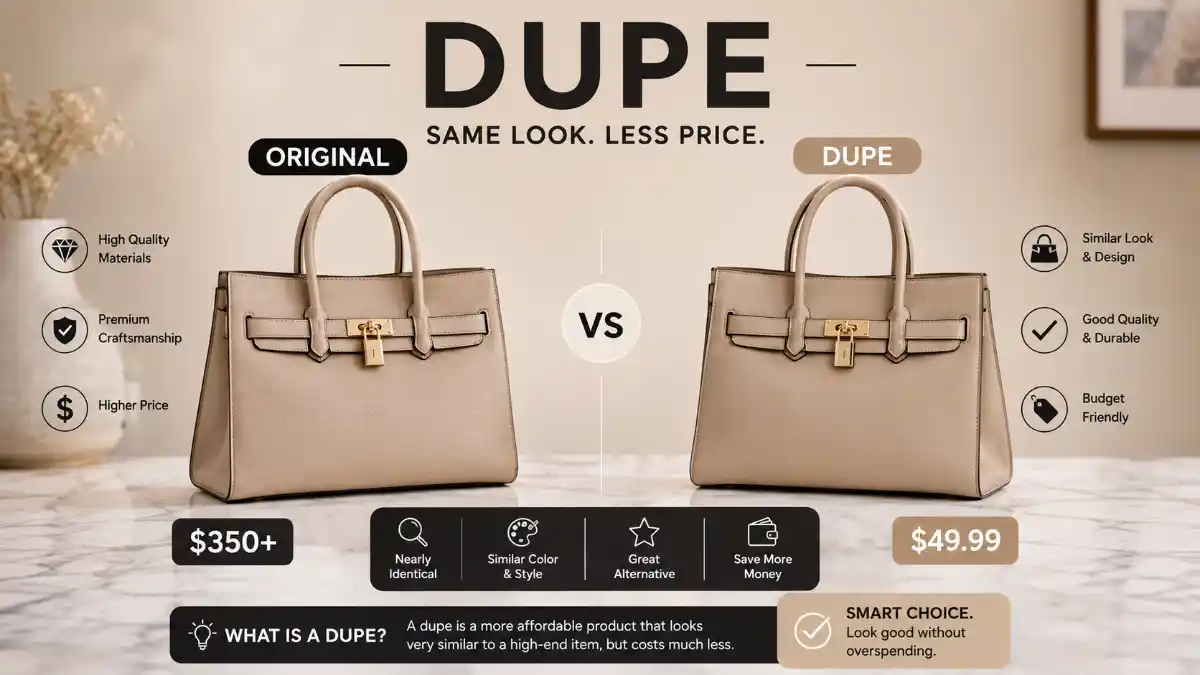

A dupe is a lower-priced product that offers a similar look, style, function, or overall experience to a more expensive product without being sold as the original. You will commonly see the term in beauty, skincare, fashion, accessories, and other consumer-product categories.
The important distinction is that a dupe is an alternative, not necessarily a fake. A product can resemble a popular designer bag, makeup product, fragrance, or clothing item while being sold under a different brand and without claiming to be the original.
That difference matters when you’re comparing price, quality, branding, and authenticity. Here’s what the term means, how dupes differ from counterfeits and knockoffs, and how to decide whether an affordable alternative is actually worth buying.
What Does “Dupe” Mean?
In shopping language, dupe is short for “duplicate.” It generally describes a product that resembles another, usually more expensive, product in one or more important ways.
The similarity can involve:
- Appearance or design
- Color or shade
- Ingredients or formulation
- Materials
- Shape or silhouette
- Function
- Texture or finish
- Overall user experience
For example, a budget lip product might have a similar shade and finish to a luxury lipstick. A less expensive blazer might have a similar cut and styling to a designer version. A skincare product might use comparable ingredients or aim for a similar result.
However, “similar” does not mean “identical.”
A good alternative can reproduce the feature shoppers actually want without reproducing every detail of the original. That is why the word is commonly used in product comparisons rather than as a strict technical classification.
What Is a Dupe in Beauty and Fashion?
The meaning changes slightly depending on the category.
In beauty, shoppers usually look for similarities in shade, texture, finish, ingredients, packaging style, or performance. A makeup alternative may be considered a match because it produces a similar appearance, while a skincare alternative may be compared more closely by formulation and ingredients.
In fashion, the comparison is often visual. Shoppers may look for a similar silhouette, fabric appearance, color, hardware, or overall styling at a lower price.
This creates an important limitation: two products can look similar but perform very differently.
A fashion item can have a nearly identical silhouette but use a thinner fabric or weaker construction. A cosmetic product can have a similar color but behave differently on the skin. A skincare product can contain a similar headline ingredient while using a substantially different formulation.
So the best question is not simply, “Does it look the same?”
It is:
“Does it deliver the specific feature I wanted from the original?”
Dupe vs. Counterfeit vs. Knockoff
These terms are often used interchangeably online, but they can describe different things.
| Term | What it generally means | Main concern |
| Dupe | A lower-priced alternative that resembles another product while being sold as its own product | Quality and value vary |
| Counterfeit | An unauthorized product presented using another brand’s trademark or branding | Authenticity, consumer deception, and legal issues |
| Knockoff | An informal term for a product that imitates another product or style | Meaning varies depending on context |
A counterfeit is particularly different because the seller may use another company’s brand identity to make buyers believe the product is genuine. The U.S. Patent and Trademark Office explains that trademarks identify the source of goods and help distinguish one company’s products from another’s. Unauthorized use that creates confusion about the source can raise trademark-infringement issues.
A dupe, by contrast, is normally understood as an alternative sold under its own branding.
Is a Dupe the Same as a Fake?
No.
“Fake” is usually used to describe a counterfeit or imitation that is being represented as the genuine branded product. A dupe is generally positioned as an alternative rather than the authentic item.
For example, a handbag from Brand A that has a similar shape to a designer handbag can be described as an affordable alternative. A handbag carrying the designer’s unauthorized logo and being advertised as authentic is a very different situation.
That distinction is important for shoppers because the presence of another company’s branding is a major warning sign.
Are Dupes Legal?
There is no single worldwide legal rule saying that every product described as a “dupe” is legal or illegal.
In the United States, the legal question can involve trademarks, consumer confusion, design rights, copyright, patents, trade dress, advertising claims, and other factors. The USPTO notes that trademark infringement generally concerns unauthorized trademark use that is likely to cause confusion, deception, or mistake about the source of goods or services.
That means visual similarity alone does not automatically determine whether a product is unlawful.
At the same time, calling something a dupe does not protect a seller from legal liability. A product can cross legal boundaries depending on how it uses another company’s protected intellectual property and how it is marketed.
The rules can also differ outside the United States. Shoppers in the UK, EU, India, and other markets should not assume that a U.S.-based explanation applies identically in their country.
For consumers, the safest practical distinction is simple: an honestly branded alternative is different from a product that uses another company’s trademarks or falsely claims to be authentic.
How to Tell a Dupe From a Counterfeit
When shopping online, look beyond the product photo.
1. Check the brand name
A legitimate alternative should normally be sold under the seller’s or manufacturer’s own brand.
If a listing uses the original brand name even though the seller is not authorized to sell that product, investigate carefully.
2. Look at the logo
An unauthorized logo is one of the clearest warning signs that you’re no longer dealing with an ordinary alternative.
The USPTO describes counterfeits as goods that use familiar brand names or logos on products not produced by the brand owner.
3. Be skeptical of unusually low prices
A dramatic price difference does not automatically prove that an item is counterfeit, but an implausibly low price should make you investigate the seller, product description, and authenticity claims.
The USPTO also lists unusually low prices as one warning sign consumers should consider when evaluating potentially counterfeit products.
4. Check where the product is sold
Look at the retailer, seller information, return policy, and customer reviews.
Buying directly from a brand or an established retailer generally gives you more information about what you are actually purchasing than an anonymous marketplace listing.
5. Read the product description carefully
Words such as “authentic,” “genuine,” or “original” deserve extra attention when the price is dramatically below normal retail pricing.
A seller should be clear about the product’s actual brand and identity.
How to Judge Whether a Dupe Is Actually Good
Finding a lower price is easy. Finding a lower-priced product that is genuinely useful is harder.
Instead of judging an alternative only by its appearance, compare the characteristics that matter for the product category.
| Factor | What to Check | Why It Matters |
| Price | Total cost compared with alternatives | Shows whether the savings are meaningful |
| Materials | Fabric, leather, metals, plastics, or other materials | Can affect durability and feel |
| Ingredients | Full ingredient list for beauty products | Helps identify meaningful formulation differences |
| Construction | Stitching, seams, hardware, lining, closures | Helps assess fashion-product durability |
| Performance | Recent reviews and independent experiences | Shows whether the product works as expected |
| Seller | Reputation, return policy, product information | Reduces purchasing risk |
| Branding | Product’s own brand and labeling | Helps distinguish an alternative from a counterfeit |
The right comparison depends on what you’re buying.
Read More: Dupe
How to Evaluate Beauty Dupes
Beauty products require more than a packaging comparison.
Makeup
For makeup, compare:
- Shade
- Finish
- Texture
- Coverage
- Wear time
- Applicator
- Ingredient list
- Skin compatibility
A product that looks similar in a promotional image may behave differently once applied.
For example, two lip products can have nearly identical shades but differ significantly in texture, pigmentation, longevity, or comfort.
Skincare
Skincare comparisons require even more caution.
Look at the complete ingredient list rather than assuming two products are equivalent because both advertise the same headline ingredient. Concentration, supporting ingredients, formulation, skin type, and product stability can all influence the experience.
A similar ingredient list does not guarantee identical results.
If you have sensitive skin or known allergies, check the complete ingredient list and follow the product’s directions rather than relying on the word “dupe” as a quality or safety guarantee.
Fragrance
Fragrance alternatives are commonly judged by scent profile and longevity. However, smelling similar at first application does not mean two fragrances will develop identically over several hours.
Consider:
- Opening notes
- Dry-down
- Longevity
- Projection
- Ingredients
- Bottle size
- Price per milliliter
This gives you a much more useful comparison than simply asking whether the scent is “the same.”
How to Evaluate Fashion Dupes
Fashion alternatives should be judged by construction as well as appearance.
Check the:
- Fabric composition
- Fabric weight
- Stitching
- Lining
- Zippers and buttons
- Seams
- Hardware
- Fit
- Care instructions
A photograph can hide major differences.
Two jackets may have the same general shape, for example, while one uses better fabric, stronger stitching, and a more substantial lining. The cheaper piece may still be the better purchase for someone who wants the look for occasional wear, but it should not automatically be treated as equivalent in construction.
This is where value matters more than simple price.
Are Expensive Products Always Better Than Their Dupes?
No.
Price can reflect many things besides product performance, including materials, manufacturing, branding, distribution, design development, retail costs, packaging, and brand positioning.
At the same time, a lower price does not automatically mean better value.
A $30 product that needs to be replaced repeatedly may be less economical than a $60 product that lasts substantially longer. Conversely, paying more for a brand name may not provide enough additional benefit for a shopper who mainly wants a particular color, shape, or basic function.
The best comparison is therefore not:
Original vs. cheap.
It is:
What am I paying for, and how much of that value does the alternative actually provide?
Why Dupe Culture Became So Popular
The term has become especially visible through social media, where creators regularly compare expensive products with cheaper alternatives.
This format works because it is easy to understand visually. A creator can place two products side by side and immediately show differences in color, size, packaging, texture, styling, or finish.
Social platforms also make product discovery faster. A shopper who would never have searched for a lower-cost alternative can encounter one through a short video, product comparison, review, or shopping recommendation.
But viral popularity should not be confused with proof of quality.
A product can become popular because it looks impressive on camera, while real-world performance, sizing, durability, or customer service may tell a different story.
What Are the Most Common Types of Dupes?
Affordable alternatives appear across many consumer categories.
Beauty dupes
Common examples include:
- Lipsticks
- Lip oils
- Foundations
- Blushes
- Highlighters
- Eyeshadow products
- Moisturizers
- Cleansers
- Fragrances
Fashion dupes
Common categories include:
- Blazers
- Dresses
- Shoes
- Handbags
- Sunglasses
- Jewelry
- Denim
- Outerwear
Home and lifestyle products
The same concept can also appear in:
- Home décor
- Kitchen products
- Accessories
- Furniture styles
- Tech accessories
- Fitness products
The common thread is not the category. It is the shopper’s search for a less expensive option that provides some of the qualities associated with a more expensive product.
How to Shop for Affordable Dupes Without Wasting Money
A smart shopping process can prevent most disappointing purchases.
Start with the feature you actually want
Ask why you want the original.
Is it the:
- Appearance?
- Color?
- Function?
- Material?
- Formula?
- Brand experience?
- Durability?
- Specific design feature?
Once you know the answer, you can evaluate alternatives much more accurately.
Compare specifications, not just photographs.
Read dimensions, materials, ingredients, weight, size information, and care instructions where available.
A photograph shows appearance. Specifications tell you what you’re actually buying.
Read recent reviews
Focus on reviews that describe real use rather than one-line reactions.
Look for repeated comments about:
- Quality
- Sizing
- Color accuracy
- Durability
- Texture
- Performance
- Packaging
- Returns
One negative review may be an outlier. A recurring complaint is more useful.
Read More: Dupe
Check the return policy
Even a highly rated product can be wrong for you.
A clear return policy reduces the downside when sizing, color, texture, or quality does not match expectations.
Compare total value
Don’t compare sticker prices alone.
Consider the quantity, shipping cost, expected lifespan, replacement frequency, and actual performance.
A lower upfront price is not always a lower overall cost.
When a Dupe May Be Worth Buying
An affordable alternative can make sense when the feature you care about is available at a significantly lower cost.
It may be a good choice when:
- You mainly want the appearance.
- You only plan to use the product occasionally.
- The alternative has strong recent reviews.
- Materials or ingredients meet your expectations.
- The seller has a reasonable return policy.
- You do not need the original brand experience.
- The price difference is meaningful.
The decision becomes less attractive when the original’s value comes from something the alternative cannot realistically reproduce, such as a particular material, construction standard, warranty, service, or authenticated ownership experience.
When You Should Be More Careful
Be cautious when a listing:
- Uses another company’s logo without authorization.
- Claims an unauthorized product is authentic.
- Has an implausibly low price.
- Provides little information about the seller.
- Uses copied product photographs without clear product details.
- Has repeated complaints about authenticity.
- Makes unusually strong performance or safety claims without supporting information.
Counterfeit products can also create safety concerns in categories such as cosmetics, personal-care products, electronics, and other goods where quality control matters. The USPTO specifically warns that counterfeit consumer products may lack appropriate quality or safety controls.
The Bottom Line on Dupes
A dupe is best understood as a lower-cost alternative that captures some of the appeal of another product without necessarily being the original product.
The smartest way to shop is to separate three questions: Is it legally and honestly sold as its own product? Does it actually deliver the feature you want? And is the price justified by its quality?
That approach is more useful than assuming every affordable alternative is either an amazing bargain or a bad copy.
A good alternative does not have to be identical to the original. It simply has to provide enough of the value you care about to make the purchase worthwhile.
Frequently Asked Questions
What does dupe mean in shopping?
A dupe is a lower-priced product that resembles a more expensive product in appearance, function, materials, ingredients, or overall experience. It is generally sold as an alternative rather than as the original branded item.
Is a dupe the same as a counterfeit?
No. A counterfeit is generally intended to deceive consumers about a product’s brand or authenticity, often through unauthorized trademarks or logos. A dupe is normally sold under its own branding as an alternative.
Are dupes always cheaper than the original?
Not necessarily, although affordability is usually part of the reason shoppers call something a dupe. The actual price difference depends on the products being compared.
Are beauty dupes safe?
The word “dupe” does not guarantee safety or quality. For beauty products, check the full ingredient list, seller information, labeling, and current customer feedback rather than relying only on a social-media recommendation.
Are fashion dupes the same quality as designer products?
Not automatically. A fashion alternative may reproduce the general appearance while using different fabrics, construction methods, hardware, or finishing. Compare the materials and construction rather than judging from photographs alone.
How can I tell if a product is a counterfeit?
Look for unauthorized brand names or logos, false authenticity claims, suspiciously low prices, poor packaging, questionable sellers, and inconsistent product information. These signs do not independently prove counterfeiting, but they justify additional verification.
Can a dupe look almost identical to the original?
Yes. Similarity in appearance is one reason products are described as dupes. However, visual similarity does not mean the materials, formulation, construction, durability, or performance are identical.
Why are dupes so popular on social media?
Side-by-side comparisons are easy to understand and share. Social platforms allow creators to demonstrate similarities and differences quickly, which can turn inexpensive alternatives into viral shopping discoveries.
Should I buy a dupe or the original?
It depends on what matters to you. If you mainly want a similar appearance or basic function, an alternative may provide better value. If you care about specific materials, construction, warranty, brand service, or authenticated ownership, the original may justify its higher price.
Do dupe laws work the same in every country?
No. Intellectual-property and consumer-protection rules differ between countries and can depend on the product, branding, design, marketing, and other circumstances. U.S. trademark guidance should not be treated as universal legal advice.