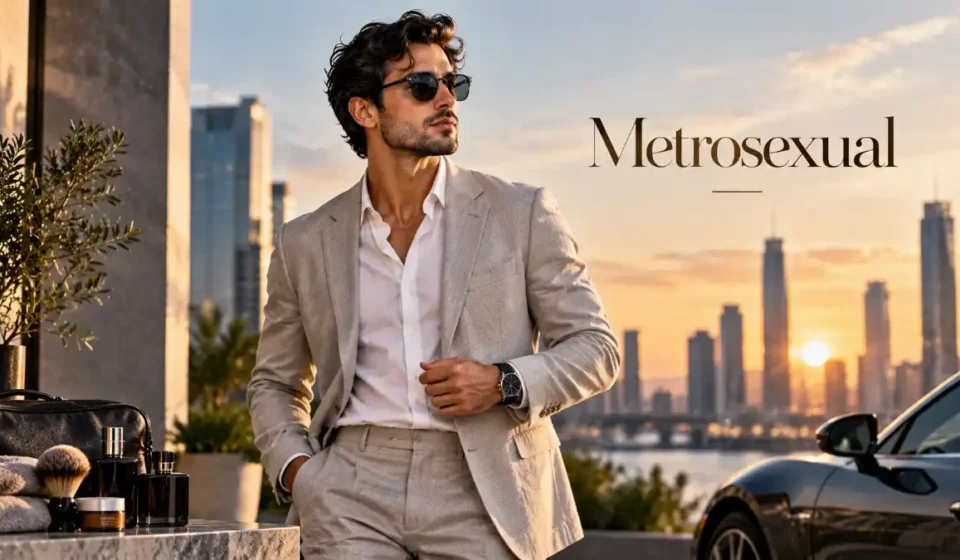

The term metrosexual describes a man who places a strong emphasis on fashion, grooming, personal appearance, and style. The word originally became associated with urban, fashion-conscious heterosexual men, but its historical meaning is more complicated than that simple definition suggests. It describes appearance and lifestyle rather than sexual attraction.
Today, the term can sound dated because many of the grooming and fashion habits once considered distinctive are now mainstream. Skincare, carefully styled hair, fragrance, tailored clothing, and regular personal-care routines are no longer unusual among men.
Understanding the metrosexual meaning therefore requires looking at both the original definition and the cultural change that made the word less common.
What Does Metrosexual Mean?
In simple terms, metrosexual refers to a man who is particularly interested in his appearance, including clothing, grooming, skincare, hair, fragrance, and personal style.
Traditional dictionary definitions often connect the term with heterosexual men who live in cities and take an interest in fashion and appearance. Oxford Learner’s Dictionaries, for example, defines the noun in terms of a heterosexual man living in a city who is interested in fashion, shopping, and his appearance.
However, modern usage can be broader than that original dictionary definition. The term is fundamentally about self-presentation rather than a person’s sexual orientation.
That distinction is important because the word can easily be misunderstood. A man’s interest in skincare, fashion, or grooming does not tell you who he is attracted to.
Read More: Metrosexual
Metrosexual Definition in Plain English
A straightforward metrosexual definition would be:
A man who places unusually strong attention on fashion, grooming, appearance, and personal style.
The word was particularly associated with men who were comfortable spending time and money on appearance-related products and services.
Examples might include:
- Following fashion trends
- Buying well-fitted or designer clothing
- Maintaining a detailed skincare routine
- Getting carefully styled haircuts
- Using fragrances regularly
- Getting manicures or pedicures
- Paying close attention to accessories
- Treating personal presentation as an important part of everyday life
None of these activities individually makes someone metrosexual. The original concept was about the broader combination of fashion consciousness, grooming, consumer behavior, and self-presentation.
Where Did the Word Metrosexual Come From?
The word metrosexual is generally credited to British journalist and cultural commentator Mark Simpson.
Simpson used the word in his 1994 essay “Here Come the Mirror Men,” published in The Independent. Simpson’s own archive identifies the essay as the first appearance of the word in print.
The term combines “metropolitan” and “heterosexual.” The first part points toward urban life, while the second was used in the original construction to distinguish the emerging male consumer from traditional stereotypes of heterosexual masculinity.
The word did not immediately become a global mainstream expression. Its wider cultural breakthrough came years later.
In July 2002, Simpson revisited the idea in his Salon.com essay “Meet the Metrosexual.” He used David Beckham as a highly visible example of the type of male image he was describing. Simpson’s archive identifies that essay as an important moment in the word’s introduction to a wider U.S. audience.
The David Beckham Connection
David Beckham became strongly associated with the term because his public image combined football, fashion, grooming, hairstyles, advertising, and experimentation with personal style.
Importantly, Beckham did not create the concept. Mark Simpson had already introduced the word years earlier. Beckham became an especially recognizable example of the image that the term came to represent.
His visibility helped make male grooming and fashion-consciousness easier to discuss in mainstream popular culture.
The association also demonstrates why the word became so closely connected with celebrity culture. A metrosexual man was no longer simply imagined as someone who bought expensive clothes. He could also be a highly visible public figure whose appearance was part of his professional identity.
Read More: Metrosexual
Why the Term Became Popular
The popularity of the term reflected a wider change in how masculinity was being represented.
Men’s fashion, grooming, advertising, celebrity culture, and lifestyle media increasingly presented appearance as something men could actively manage rather than something they were expected to ignore.
The concept also challenged an older stereotype: that excessive attention to appearance was inherently feminine or incompatible with conventional masculinity.
In that context, the word gave journalists and marketers a convenient label for a recognizable cultural shift.
The American Dialect Society eventually selected metrosexual as its 2003 Word of the Year, defining it as a fashion-conscious heterosexual male and referencing Simpson’s description of the type.
What Is a Metrosexual Lifestyle?
The metrosexual lifestyle was less about one particular product or grooming habit and more about treating appearance as an important part of everyday self-presentation.
A person associated with the concept might invest considerable attention in several areas.
Metrosexual Fashion
Metrosexual fashion traditionally emphasized a polished, intentional appearance.
Common characteristics included:
- Well-fitted clothing
- Awareness of current fashion trends
- Coordinated colors and textures
- Interest in designer or premium labels
- Attention to footwear
- Accessories such as watches, bags, or jewelry
- Dressing appropriately for different social settings
The important point was intentionality. Clothing was not merely functional. It became part of personal identity and presentation.
Metrosexual Grooming
Metrosexual grooming commonly included more attention to personal care than traditional masculine stereotypes expected.
Examples could include:
- Regular skincare
- Moisturizer and other facial-care products
- Carefully styled hair
- Facial-hair maintenance
- Manicures and pedicures
- Fragrance
- Body-hair grooming
- Professional beauty or grooming treatments
Again, none of these behaviors is exclusive to this label. Men have cared about grooming throughout history. What distinguished the early-2000s concept was the cultural visibility and combination of these behaviors.
Shopping and Consumer Culture
Shopping was another important part of the original concept.
The stereotypical metrosexual consumer was comfortable researching clothing, grooming products, fragrances, accessories, and lifestyle goods. Appearance could become a form of self-expression as well as a way of communicating social identity.
This consumer dimension was particularly important to Simpson’s original cultural commentary, which connected the emerging male identity with advertising and consumer culture.
Read More: Metrosexual
Is Metrosexual About Sexual Orientation?
No. The term is primarily a description of appearance, grooming, fashion, and lifestyle.
This is one of the most important points in understanding the word.
The original popular definition focused heavily on heterosexual men, which is why the word contains “sexual.” But the suffix does not mean that grooming habits determine someone’s sexual orientation.
A person’s fashion choices, skincare routine, haircut, fragrance, or interest in clothing cannot establish their sexual orientation.
The term’s history is also more complicated than its dictionary definition. Simpson’s original writing discussed male self-presentation in relation to both heterosexual and gay culture, which makes the modern assumption that the word simply means “straight man who likes fashion” an incomplete explanation.
Was Marian Salzman the Person Who Coined the Term?
No. Mark Simpson is generally credited with coining the word in 1994.
Marian Salzman played an important role in popularizing and discussing the concept during the early 2000s, particularly from a marketing and trend-analysis perspective. However, she has been reported as crediting Simpson with originating the word.
Contemporary reporting also describes Simpson as the person who coined the term in 1994.
The distinction matters because “coined the term” and “helped popularize the term” are not the same thing.
Is Metrosexual a Compliment or an Insult?
The meaning depends on context.
It can be used neutrally to describe a man’s interest in grooming and fashion. It can also be used positively to suggest that someone is polished, stylish, or highly attentive to appearance.
In other contexts, the term can be dismissive or mocking, particularly when it is used to suggest that a man’s grooming habits make him insufficiently masculine.
The word itself does not automatically carry one emotional meaning. Tone, context, and the speaker’s intention matter.
This is also one reason the term has become less useful over time. Modern conversations about men’s fashion and grooming can describe specific behaviors without placing them under a single cultural label.
Why Is the Word Metrosexual Less Common Today?
The word became less prominent partly because the behaviors associated with it became less unusual.
In the early 2000s, extensive male grooming could still be presented as a notable cultural development. Today, men’s skincare, fashion, haircare, fragrance, fitness, and personal-care routines are widely visible in mainstream culture.
That does not mean every man follows an extensive routine. It means these activities no longer require the same cultural label to explain them.
Oxford still lists the word as an informal term, while contemporary usage often focuses more directly on fashion, grooming, or appearance instead.
Read More: Metrosexual
The Behavior Survived the Label
The decline of the word does not mean the underlying behavior disappeared.
Instead, the vocabulary became more specific.
Someone might now describe himself as:
- Fashion-conscious
- Well-groomed
- Interested in men’s skincare
- Into men’s fashion
- Style-conscious
- Focused on personal care
- Interested in self-care
These descriptions explain the behavior without requiring a broad cultural label.
Metrosexual vs. Spornosexual vs. Lumbersexual
Several other terms became popular during or after the period when metrosexual was prominent.
| Term | Main Focus | How It Relates |
| Metrosexual | Fashion, grooming, appearance, urban style | Broad original concept |
| Spornosexual | Muscular physique, fitness, grooming, visual presentation | More body- and fitness-focused |
| Lumbersexual | Rugged or outdoors-inspired appearance | A contrasting style built around a deliberately rugged aesthetic |
Read More: Metrosexual
These labels should not be treated as exact categories. They are cultural descriptions that emerged at different points and emphasize different aspects of men’s appearance.
The larger trend is more useful than the labels themselves: men’s appearance became increasingly open to experimentation, consumer spending, and deliberate self-presentation.
Modern Male Grooming and the Metrosexual Legacy
Modern male grooming can be understood as part of the cultural shift that the word once attempted to describe.
Men today have access to a much wider range of skincare, haircare, fragrance, fashion, and personal-care products than was typically associated with men’s consumer culture in previous decades.
A man can use facial cleanser, moisturizer, sunscreen, hair products, fragrance, beard products, or professional grooming services without those choices necessarily being treated as unusual.
That makes the older label less necessary.
The metrosexual legacy is therefore less about preserving the word and more about understanding the change in expectations surrounding male appearance.
What once required a special label can eventually become ordinary.
What Does a Metrosexual Man Look Like?
There is no single appearance that defines a metrosexual man.
The stereotype often involves fashionable clothing, carefully maintained hair, and clear attention to skincare, fragrance, and accessories. But these are cultural associations rather than a fixed checklist.
A man does not need to wear designer clothes, visit a salon regularly, or follow a complex skincare routine to fit the historical concept.
Likewise, being interested in grooming does not automatically make someone metrosexual.
The term is best understood as a broad cultural description of unusually deliberate attention to appearance rather than a strict personality or fashion category.
Is Metrosexual Still Relevant?
The word remains useful when discussing the history of men’s fashion, grooming, advertising, masculinity, and consumer culture.
It is less useful as a precise description of contemporary men because modern grooming culture is much more diverse.
The original concept grouped several behaviors under one label. Modern language tends to separate them.
For example, someone may be highly interested in skincare but uninterested in fashion. Another person may follow designer clothing but have a very simple grooming routine. Someone else may focus primarily on fitness and body presentation.
Those differences are easier to describe individually than through one broad term.
The Meaning of Metrosexual Today
The modern metrosexual meaning is therefore best understood in two layers.
Historically, it described an urban, fashion-conscious man—particularly a heterosexual man—who was unusually attentive to appearance, shopping, grooming, and style.
In contemporary discussion, the word is often used more loosely to describe a man who is highly conscious of his appearance and personal presentation.
The historical definition remains important because it explains why the term became culturally significant. But its original boundaries should not be treated as a scientific or universal classification.
Conclusion
Metrosexual is a cultural term for a man associated with strong attention to fashion, grooming, appearance, and personal style. Mark Simpson introduced the word in print in 1994, and his later 2002 essay helped bring it to a much wider audience. David Beckham became one of its most recognizable cultural examples, while the American Dialect Society selected it as its 2003 Word of the Year.
The word eventually became less common because many of the behaviors it described became normal parts of men’s fashion and personal care. Skincare, fragrance, carefully styled hair, fashion awareness, and deliberate grooming no longer need one umbrella label.
So, although the word may sound dated, the cultural shift behind it remains relevant. The story of metrosexual helps explain how men’s grooming and fashion moved from something that could be treated as unusual into an accepted part of modern self-presentation.
Frequently Asked Questions
What does metrosexual mean in simple terms?
It describes a man who places significant attention on his fashion, grooming, personal appearance, and style. The historical term was especially associated with urban heterosexual men, although modern discussions may use it more broadly.
Who coined the word metrosexual?
British journalist Mark Simpson is credited with introducing the word in print in his 1994 Independent essay “Here Come the Mirror Men.” He later discussed the concept in his 2002 Salon.com essay.
Does metrosexual describe sexual orientation?
No. The term describes appearance, grooming, fashion, and lifestyle rather than sexual attraction. The historical definition often specified heterosexual men, but grooming or fashion choices cannot determine someone’s sexual orientation.
Why is David Beckham associated with metrosexual culture?
Mark Simpson identified Beckham as a prominent example of the emerging type in his 2002 essay. Beckham’s public image combined football, fashion, grooming, hairstyles, and celebrity culture, making him strongly associated with the term.
Is metrosexual still a commonly used word?
It is much less prominent than it was during the early 2000s. The behaviors associated with the term have become more mainstream, so people can now describe fashion, skincare, or grooming directly without using the broader label.
What is the difference between metrosexual and spornosexual?
Metrosexual traditionally emphasizes fashion, grooming, and overall appearance. Spornosexual is a later concept that places greater emphasis on a muscular physique, fitness, grooming, and visual presentation.
Can a gay or bisexual man be metrosexual?
The historical popular definition emphasized heterosexual men, but the term itself describes appearance and lifestyle rather than attraction. A person’s grooming or fashion choices do not determine their sexual orientation.
Was Marian Salzman the person who coined metrosexual?
No. Mark Simpson is credited with coining the word in 1994. Salzman later helped popularize and discuss the concept in marketing and trend analysis. Contemporary reporting also identifies Simpson as the originator.
Why did the metrosexual trend become less visible?
Many of the behaviors associated with the trend became ordinary parts of men’s grooming and fashion culture. As skincare, styling, fragrance, and fashion-consciousness became more mainstream, the need for a single label became weaker.
What is a modern alternative to the term metrosexual?
There is no single replacement. Depending on the behavior being described, terms such as “well-groomed,” “fashion-conscious,” “style-conscious,” “men’s grooming enthusiast,” or “interested in men’s skincare” can be more specific.