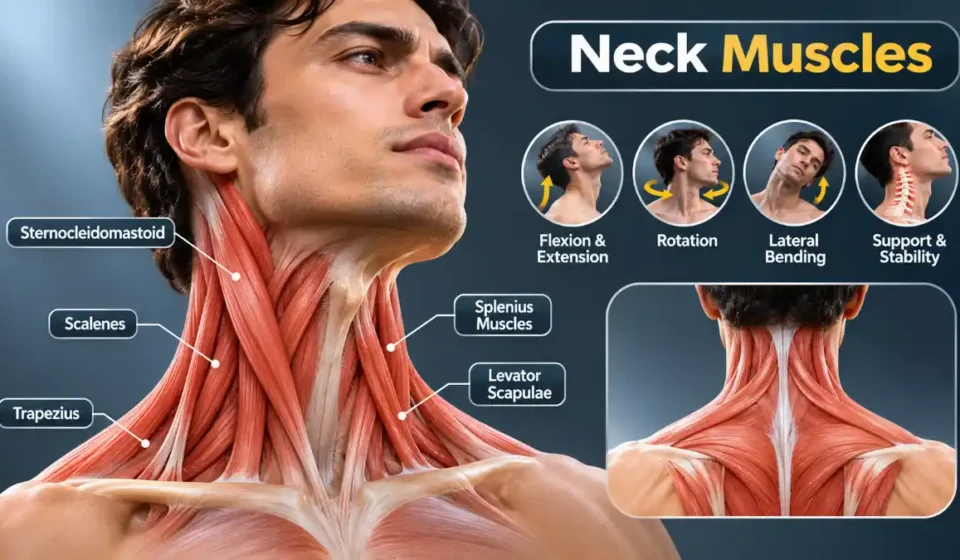

Neck muscle groups are made up of skeletal muscles that provide support to the head, control and steady the cervical spine, and enable you to rotate, bend forward/backward/sideways, and elevate/depress your head. The major neck muscle groups include the sternocleidomastoid, trapezius, scalenes, levator scapulae, splenius muscles, and deep cervical muscles. Certain neck muscles may also assist in swallowing, moving the jaw, and breathing.
The position of the muscles in the neck will help you understand their functions. The muscles in your neck can either be located near the surface of the skin (superficial) or deep within the tissue surrounding the cervical spine (deep). By understanding the function of each group of muscles, you can gain a better understanding of how the head moves each day, and why some parts of the neck may experience stiffness or pain.
Major Neck Muscles: Names, Locations, and Functions
Most movements of the head and neck are caused by multiple muscles working together to provide support for stability and movement. Although each muscle has a specific job to do, most movements require the use of several muscles.
| Muscle or Group | Location and Depth | Primary Function |
| Sternocleidomastoid (SCM) | Superficial, front and sides | Rotates and tilts the head; assists flexion |
| Upper trapezius | Superficial, back of neck and shoulders | Moves the shoulder blades; assists neck movement |
| Levator scapulae | Deeper posterolateral neck | Elevates the shoulder blade; assists neck movement |
| Scalenes | Deep lateral neck | Assist side bending and breathing |
| Splenius capitis | Posterior neck, beneath superficial muscles | Extends and rotates the head |
| Splenius cervicis | Posterior neck, deeper layer | Extends and rotates the neck |
| Semispinalis capitis | Deep posterior neck | Extends and stabilizes the head |
| Longus colli | Deep anterior neck | Flexes and stabilizes the cervical spine |
| Longus capitis | Deep anterior neck | Assists head and upper neck flexion |
| Suboccipital muscles | Deep, base of skull | Control small head movements and stabilization |
| Suprahyoid muscles | Above the hyoid bone | Assist swallowing and jaw opening |
| Infrahyoid muscles | Below the hyoid bone | Move and stabilize the hyoid during swallowing |
| Platysma | Very superficial, front of neck | Tenses neck skin and assists facial and jaw movements |
These groups of muscles describe where they are located in relation to other structures. Depending upon which system you use to classify them, some of these groups can fall into more than one category.
Superficial vs. Deep Neck Muscles
The superficial neck muscles are located closer to the surface of the skin. Examples of superficial neck muscles include the platysma, sternocleidomastoid, and upper trapezius. Each muscle contributes to the overall appearance of the neck. In addition to contributing to the shape of the neck, these muscles also contribute to the movement of the head as well as to movements of the jaw and/or shoulder.
Deep neck muscles are positioned underneath the superficial layer, and they typically reside near the cervical vertebrae. Important examples include the longus colli, longus capitis, deep posterior cervical extension muscles, and suboccipital muscles.
The deeper muscles provide support for the smaller and more precise movements of the cervical spine, while providing stability to the cervical spine. However, the deeper muscles are not solely responsible for stabilizing the cervical spine. Both superficial and deep muscles are used to support the head and to coordinate movement.
Front, Side, and Back Neck Muscles
Front Neck Muscles
The front of the neck has muscles that allow the neck to be bent forward (flexing) as well as helping with chewing, swallowing, and moving the jaw.
The sternocleidomastoid muscle begins at the sternum and clavicle and extends to the mastoid process of the skull located behind the ear. In addition to being a primary muscle in the neck, it serves as a boundary between the anterior and posterior cervical triangles. These triangles are considered to be anatomical regions as opposed to individual muscle groups.
NCBI
In the lower part of the anterior neck, the longus colli and longus capitis are located on each side of the anterior surface of the cervical spine. Both muscles assist with flexion of the neck and head in a controlled manner, and contribute to the overall stability of the cervical spine.
Several smaller muscles lie around the hyoid bone. The suprahyoid muscle group (the digastric, mylohyoid, geniohyoid, and stylohyoid muscles) aids in movement of the hyoid and assists in swallowing. Underneath the hyoid bone, the sternohyoid, omohyoid, sternothyroid, and thyrohyoid muscles function to position or stabilize the hyoid bone and surrounding structures.
Side Neck Muscles
The lateral aspect of the neck contains the sternocleidomastoid muscle (SCM), three scalene muscles (anterior, middle, posterior), and a portion of the levator scapulae muscle.
The front (anterior), middle (middle), and back (posterior) scalene muscles are located on each side of your neck, stretching from your upper back (cervical spine) to the bottom of your rib cage. These muscles assist with side-to-side movement of your head and, when you inhale deeply, they pull up on the first few ribs.
NCBI
The levator scapula connects the top of the neck to the back of the shoulder. While its primary function is to lift the shoulder blade, it may also assist with head movement when the shoulder blade does not move.
Together, these muscles are involved with the position of your head, side-to-side bending, and how you coordinate the movements of your neck and shoulders.
Back of Neck Muscles
The muscles on the back of your neck assist with extending and rotating your head as well as providing support to your head in various positions.
The upper trapezius muscle is located over the upper portion of the back of the neck and shoulders. Underneath the more surface muscles, Splenius Capitis Muscle and Splenius Cervicis Muscle will allow you to bend your head and neck backward. When you contract either of those muscles on one side, you can turn your head or neck towards that same side.
The semispinalis capitis is a deep muscle of the posterior neck that provides control over head extension and other controlled movements.
At the base of the skull are four paired suboccipital muscles:
NCBI
- Rectus capitis posterior major
- Rectus capitis posterior minor
- Obliquus capitis superior
- Obliquus capitis inferior
These are small muscles that provide control of the subtle movements of the skull relative to the top vertebra of the neck. Additionally, these muscles play a role in proprioception (the ability of the body to recognize where your head is located and how it moves).
How Do Neck Muscles Move and Support the Head?
The cervical spine contains seven vertebrae labeled C1 through C7. There are many different types of neck muscles that attach to various parts of the body such as the skull, vertebrae, ribs, shoulder girdle, etc. These muscles help to move the joints of the cervical spine by contracting and relaxing, while also providing stability.
Muscle involvement varies depending on which type of movement is occurring within the neck, as described by the anatomy of neck movement.
NCBI
| Movement | Important Contributing Muscles |
| Looking downward (flexion) | Longus colli, longus capitis, sternocleidomastoid |
| Looking upward (extension) | Splenius muscles, semispinalis capitis, other posterior extensors |
| Turning the head (rotation) | Sternocleidomastoid, splenius muscles, suboccipital muscles |
| Tilting sideways (lateral flexion) | Sternocleidomastoid, scalenes, levator scapulae |
| Stabilizing the head | Deep cervical flexors, extensors, and supporting muscles |
A single muscle may have different actions when contracted from either side. An example is the sternocleidomastoid muscle, which has a general effect of turning the head to the opposite side and tilting the head towards the contracting side.
The primary function of each neck muscle is not always to move the head. For example, the scalenes and sternocleidomastoid can aid in forcefully exhaling air from the lungs, and some of the muscles that surround the hyoid bone are involved in coordinating swallowing.
Neck Muscle Pain, Tightness, and Strains
The neck may feel tight or uncomfortable due to muscle issues with the upper trapezius, the levator scapulae, the sternocleidomastoid, or the muscles at the back of the neck.
Muscle soreness may occur after a sudden movement, an unfamiliar form of exercise, or when experiencing physical exertion. Soreness can also be caused by holding your head in the same position for a long time (i.e., when you work on a computer).
Commonly experienced symptoms include: aching, rigidity, limitations in movement, and/or discomfort extending upwards towards either the shoulder or head. Although the point at which you experience pain can help identify where the issue may lie, it is not always indicative of which specific muscle is causing the problem.
Neck pain may also develop due to issues with the neck’s bones, discs, nerves, and other structures. When the pain does not subside, begins to radiate down one of your arms, and/or is accompanied by numbness, tingling, and/or weakness in that arm, you should seek medical attention from a health care provider to find out if the source of the pain is related to muscle damage or some other structure.
How to Keep Neck Muscles Healthy
Keeping your neck engaged in comfortable movement will help you keep the motion of your neck, its muscles working correctly, and your ability to do normal daily activities.
Controlled rotation of the neck, proper side-to-side bending of the neck, and correctly executed strength training exercises can be used to maintain flexibility and control over muscles. Also, if you sit for extended periods, altering your sitting position frequently and making adjustments to your workspace will allow you to reduce the length of time that your neck is held in one position.
When you don’t understand the reason for your pain, it’s best to avoid pushing your neck past its natural range of motion during stretching exercises, and especially when trying to adjust your neck yourself.
For common discomforts, such as sore muscles from exercise, gentle and gradual activity will usually produce better results than inactivity. On the other hand, if you experience extreme pain after suffering a traumatic injury, have a fever along with severe neck stiffness, or begin experiencing new weakness or neurological symptoms, then you should see a doctor immediately. Do not treat these symptoms as simply a pulled muscle. Additional information regarding when to seek medical help for neck pain and stiffness can be found in the Neck Pain and Stiffness Guidance.
Read also: Neck Muscles
Frequently Asked Questions
What are the main muscles in the neck?
The main neck muscles include the sternocleidomastoid, trapezius, scalenes, levator scapulae, splenius muscles, and deep cervical flexors and extensors. They work together to turn, tilt, and support the head while maintaining stability around the cervical spine.
What muscles are located at the front of the neck?
The front of the neck contains the platysma, sternocleidomastoid, longus colli, longus capitis, and muscles surrounding the hyoid bone. Some help bend the neck forward, while others contribute to swallowing and jaw movement.
What muscles are at the back of the neck?
Important posterior neck muscles include the upper trapezius, splenius capitis, splenius cervicis, semispinalis capitis, and suboccipital muscles. They help extend and rotate the head, control smaller movements, and maintain head position.
Which neck muscles turn and support the head?
The sternocleidomastoid and splenius muscles are important contributors to head rotation. The suboccipital muscles assist with smaller, controlled movements, while the deep cervical flexors and extensors help keep the head and neck stable.
What causes neck muscles to become tight or painful?
Neck muscles may feel tight or sore after strain, sudden movement, unfamiliar physical activity, or prolonged positioning. However, neck pain can also come from joints, nerves, or other cervical structures. Symptoms alone cannot reliably identify the cause.