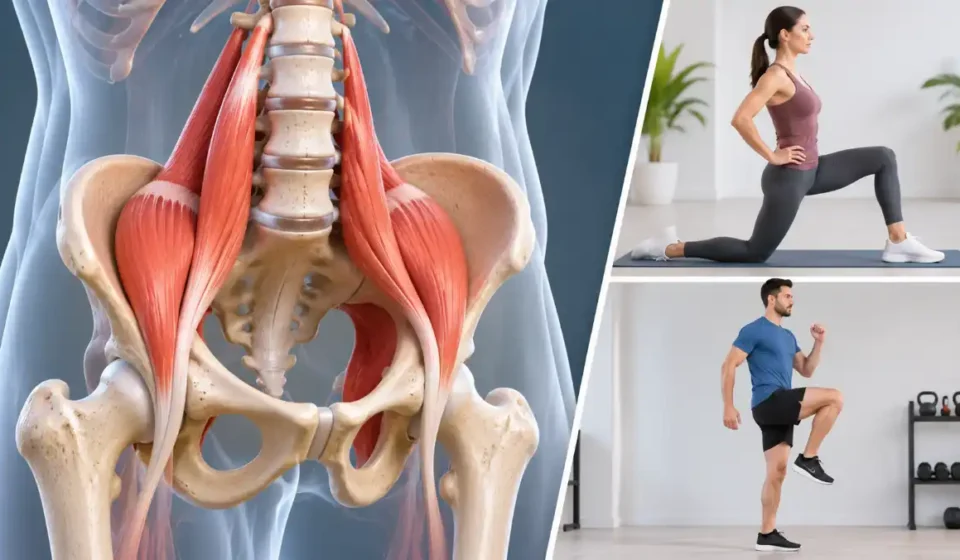

The iliopsoas muscle is a deep hip-flexor complex made up primarily of two muscles: the psoas major and iliacus. It extends from the lumbar spine and inner pelvis across the front of the hip, attaching mainly to the lesser trochanter of the femur (thigh bone). Its main job is hip flexion, which allows you to lift your knee toward your chest when walking, running, or climbing stairs.
The iliopsoas also helps stabilize the hip and supports certain trunk movements. When its muscles or tendons become injured or irritated, you may experience pain in the front of the hip or groin. Knowing how this muscle complex works can help you understand these symptoms and why improving both flexibility and strength may be useful.
Where Is the Iliopsoas Muscle Located?
The iliopsoas sits deep within the lower trunk and pelvis. It travels across the front of the hip joint before attaching to the upper femur.
Its two main muscles begin in different locations:
- Psoas major: Runs alongside the lumbar spine, beginning in the lower thoracic and lumbar vertebral region and extending downward toward the pelvis.
- Iliacus: Fills much of the iliac fossa, the broad, curved depression on the inner surface of the pelvic bone. The iliacus muscle works closely with the psoas major to flex the hip.
These muscles meet beneath the inguinal ligament and share a strong tendon that attaches mainly to the lesser trochanter of the femur.
Some people also have a smaller muscle called the psoas minor. Although it is closely associated with this muscle group, it does not form a principal part of the shared iliopsoas tendon.
Iliopsoas Muscle Anatomy: Origin, Insertion, and Innervation
The psoas major and iliacus work together to move the hip, but their attachments and nerve supply are different. These anatomical differences also explain why each muscle contributes somewhat differently to hip stability and trunk movement.
| Anatomical feature | Psoas major | Iliacus | Psoas minor (when present) |
| Origin | T12–L5 vertebral region, including vertebral bodies, discs, and transverse processes | Iliac fossa and nearby pelvic structures | T12–L1 vertebral region |
| Insertion | Lesser trochanter of the femur through the iliopsoas tendon | Mainly the lesser trochanter, with some variation in distal attachments | Iliopubic eminence and surrounding fascia |
| Innervation | Direct lumbar plexus branches, mainly L1–L3 | Femoral nerve, L2–L4 | Mainly L1 |
| Primary action | Hip flexion; assists lumbar and trunk movement | Hip flexion | Weak trunk flexion |
Blood reaches the iliopsoas through several vessels, including the lumbar and iliolumbar arteries and branches supplying the pelvis and upper thigh. Anatomical variations are common enough that some descriptions of the psoas major also include L4 nerve contributions.
Although the psoas major and iliacus share the same primary function, their different attachments mean they do not influence spinal and pelvic movement in the same way.
What Does the Iliopsoas Muscle Do?
The iliopsoas is one of the body’s most powerful hip flexors. It brings your thigh toward your torso and can also help move your trunk toward your thighs when your legs remain relatively fixed.
Its main functions include:
- Hip flexion: Lifts the knee during walking, running, climbing stairs, and stepping over obstacles.
- Hip rotation: Assists with outward (external) rotation of the thigh, depending on hip position.
- Hip stabilization: Helps maintain control between the pelvis and femur during movement.
- Trunk movement: The psoas major contributes to lumbar spine movement and stability because it attaches directly to the vertebrae.
The iliopsoas doesn’t work alone. Other muscles, including the rectus femoris and sartorius, assist with hip flexion. How much each muscle contributes depends on your position and the movement you’re performing.
Iliopsoas Muscle Pain: Causes and Symptoms
Pain involving the iliopsoas often develops in the front of the hip or groin. You might notice discomfort when raising your knee, climbing stairs, running, or getting up from a chair.
Several conditions can affect this muscle complex:
- Iliopsoas strain: Damage to muscle fibers caused by excessive stretching or loading. It may occur during sprinting, kicking, or sudden changes in movement.
- Iliopsoas tendinopathy: Pain involving the tendon, often associated with repetitive loading or a sudden increase in physical activity.
- Iliopsoas bursitis: Irritation or inflammation of the fluid-filled bursa that reduces friction between tissues near the hip.
- Internal snapping hip syndrome: A snapping or clicking sensation caused by the iliopsoas tendon moving over nearby structures. This isn’t always painful.
- Hip-flexor stiffness: A feeling of tightness or limited movement that doesn’t necessarily mean the muscle has physically shortened.
Repetitive hip flexion, sudden increases in training intensity, and certain changes following hip surgery may contribute to these problems. Hip strains can range from mild muscle-fiber injuries to more significant damage that requires longer rehabilitation.
Importantly, not all hip or groin pain comes from the iliopsoas. Problems involving the hip joint, lumbar spine, nerves, or abdominal and pelvic structures can produce similar symptoms. Lower-back discomfort or anterior pelvic tilt alone isn’t enough to diagnose an iliopsoas problem.
How Is Iliopsoas Pain Diagnosed and Treated?
A healthcare professional will usually begin by asking about your symptoms and examining how your hip moves. The assessment may include muscle-strength testing, checking for tenderness, observing your walking pattern, and evaluating pain during resisted hip flexion.
Imaging isn’t always necessary. However, ultrasound, MRI, or other tests may help when the diagnosis is unclear or a more serious injury is suspected.
Treatment depends on what’s causing the pain. Many musculoskeletal conditions improve with temporary activity changes, gradual strengthening, appropriate mobility work, and physical therapy.
For persistent tendinopathy, bursitis, or painful snapping hip syndrome, a clinician may recommend additional treatment based on the examination findings. Recovery time varies according to the condition, its severity, and how well the person responds to rehabilitation.
Seek urgent medical attention if you develop severe hip pain after an injury, cannot bear weight, have fever with significant hip pain, or experience new weakness, numbness, or other neurological symptoms. These warning signs of hip pain may indicate a problem that needs prompt evaluation.
Iliopsoas Muscle Stretches and Strengthening Exercises
Gentle stretching and progressive strengthening may help improve hip mobility and muscle function. The right approach depends on whether you’re dealing with stiffness, weakness, or an injury.
Choose comfortable, controlled movements rather than forcing your hip through a painful range. A structured hip conditioning program can also help guide safe exercise progression when recommended by a healthcare professional.
1. Half-Kneeling Hip-Flexor Stretch
Kneel on a padded surface with one foot in front of you and the opposite knee on the floor. Gently tuck your pelvis, tighten the gluteal muscles on the kneeling side, and move your hips slightly forward.
You should feel a gentle stretch along the front of your rear hip. Keep your upper body upright and avoid arching your lower back to increase the stretch.
2. Standing Knee Raises
Stand upright and hold onto a stable surface if you need help balancing. Slowly lift one knee toward waist height, pause briefly, and lower it with control.
Try not to swing your leg or lean backward. The goal is to strengthen the muscles responsible for lifting your thigh, not to raise your knee as high as possible.
3. Supine Marching
Lie on your back with your knees bent and both feet resting on the floor. Lightly engage your abdominal muscles, then lift one foot a short distance before lowering it.
Alternate legs while keeping your pelvis steady. Move slowly enough that your lower back doesn’t arch excessively or shift from side to side.
4. Progressive Resisted Hip Flexion
Start with a gentle isometric exercise, such as pressing your thigh lightly against your hand without moving your hip.
If this feels comfortable, gradually progress to controlled knee raises with suitable resistance. Increase the difficulty only as your strength and movement tolerance improve.
Important: Stretching and strengthening are not interchangeable treatments. An irritated tendon or newly injured muscle may need reduced loading rather than aggressive stretching. If you’ve recently suffered a significant injury, have unexplained hip pain, or notice worsening symptoms during hip flexion, get a professional assessment before exercising. Stop any movement that causes sharp or increasing pain.
Frequently Asked Questions
Can Prolonged Sitting Make the Iliopsoas Tight?
Sitting for long periods keeps your hips in a flexed position, which may leave them feeling stiff or less mobile. However, that doesn’t necessarily mean the iliopsoas has permanently shortened. Taking regular movement breaks, stretching gently when appropriate, and maintaining hip strength may help you stay comfortable and mobile.
How Long Does an Iliopsoas Strain Take to Heal?
Healing time depends on how severely the muscle is injured, your usual activity level, and how the injury responds to rehabilitation. A mild strain may settle relatively quickly, while more substantial injuries can take considerably longer. If pain continues, gets worse, or limits everyday activities, have it assessed rather than relying on stretching alone.


[…] by many different things, including muscle strains, ligament sprains, irritation of joints in the lumbar spine, etc. However, if you experience lower right back pain (between your lowest rib and your hip bone), […]