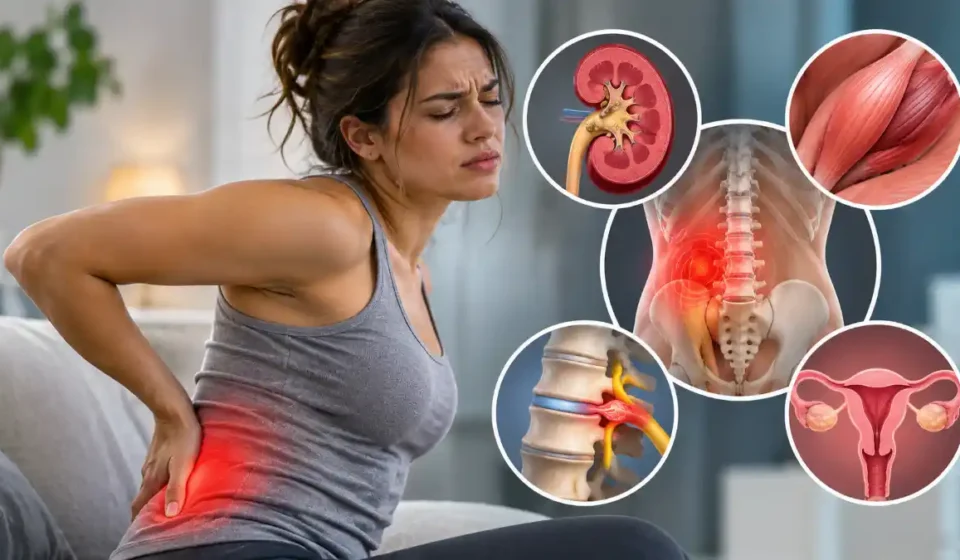

Lower right back pain can be caused by many different things, including muscle strains, ligament sprains, irritation of joints in the lumbar spine, etc. However, if you experience lower right back pain (between your lowest rib and your hip bone), it may also be due to problems with your kidneys, abdomen, or pelvic organs. The exact cause of your lower right back pain depends upon your symptoms, previous medical history, and what was found during your physical exam.
A muscle or joint issue may cause increased pain if you experience it while bending over, twisting your body, or picking up items. If you have pain that is further into the right side of your body and is accompanied by fever, nausea, or changes in how often you urinate, a kidney issue may be at play. The above-described symptoms will assist in reducing potential causes of your pain; however, they alone cannot lead to a diagnosis.
What Causes Lower Right Back Pain?
There are many conditions that can result in lower right back pain. These conditions include issues with the muscles, joints, and/or nerves, as well as problems with nearby organs.
| Possible cause | Typical pain location | Associated symptoms and clues |
| Muscle strain or ligament sprain | Right lower back | Aching, stiffness, or muscle spasms, sometimes after lifting or twisting |
| Sacroiliac (SI) joint pain | Lower back, buttock, or just above the hip | Pain when standing, walking, or changing positions |
| Lumbar facet joint irritation | One side of the lower spine | Localized discomfort that may worsen when bending backward or rotating |
| Herniated disc or sciatica | Lower back, buttock, or leg | Pain traveling down the leg, tingling, numbness, or weakness |
| Kidney stones | Right flank or back, sometimes extending toward the groin | Severe pain that may come in waves, nausea, vomiting, or blood in the urine |
| Kidney infection | Flank or back, often beneath the ribs | Fever, chills, urinary symptoms, nausea, or vomiting |
| Appendicitis | Usually the lower right abdomen, occasionally the back | Abdominal pain, nausea, loss of appetite, or fever |
| Ovarian cysts | One side of the pelvis, sometimes extending into the back | Pelvic discomfort, pressure, or sudden sharp pain |
| Endometriosis | Pelvis and sometimes the lower back | Painful periods, ongoing pelvic pain, or pain during sex |
| Pelvic inflammatory disease | Lower abdomen or pelvis, sometimes the back | Pelvic pain, unusual discharge, fever, or bleeding between periods |
Muscle and joint issues are frequent causes of backache, particularly if you have started experiencing symptoms following an exercise session. However, neither the location of the ache nor how bad the ache is will allow for identification of the cause of the ache.
Is Lower Right Back Pain From a Kidney or a Muscle?
After exercising, carrying a lot of weight, or moving in a way that is difficult for you, the muscles in your body can start to hurt. You might notice that the area where you are hurting feels tight, stiff, or sore; also, when you try to change position, the pain might be even more severe.
Usually, kidney pain will be felt in the upper part of your back or in your flank area (near the bottom of your ribs). Kidney stones typically produce sharp pains that travel from the flank area down into your groin and are experienced in wave-like patterns. If you have a kidney infection, however, you may experience both flank pain and other symptoms such as a fever, chills, or difficulty urinating.
| Feature | Muscle-related pain | Kidney-related pain |
| Location | Usually the lower back, sometimes above the hip | Often deeper in the flank, beneath the ribs |
| Onset | May follow lifting, exercise, or twisting | May begin suddenly or develop gradually |
| Movement | Often worsens with certain movements | May continue regardless of position |
| Urinary symptoms | Usually absent | May include burning, frequent urination, or blood in the urine |
| Other symptoms | Tenderness, stiffness, or spasms | Possible fever, chills, nausea, or vomiting |
The differences listed above are not used for diagnosing kidney stones. Not every patient who has kidney stones will have blood in their urine. A patient with internal problems can experience pain which increases/decreases when they move.
Why Does My Lower Right Back Hurt Above the Hip or When I Move?
Pain in the area directly above your right hip can be caused by the quadratus lumborum muscle, nearby soft tissues, lumbar joints (lower back), or the sacroiliac joint (where the spine and pelvis meet).
There is potential for an existing muscle/joint issue to become worse when you bend/twist/stand after being seated for an extended period of time. There is also the possibility of experiencing tenderness and/or muscle spasms if you have suffered a strain. However, experiencing only these two types of symptoms does not indicate that you have experienced a strain.
A spinal nerve may become irritated when you feel pain that goes from your right buttock to your leg, especially if there is also tingling or numbness. Sciatica is usually felt on only one side of your body.
Lower Right Back Pain in Females: Possible Causes
Females may suffer from the same muscle, spine, and kidney issues as all other individuals. There are, however, several unique reproductive conditions which can produce low back pain.
Ovarian cysts can result insingle-sidede pelvic pain which radiates to the back. Pelvic pain related to menstruation is a common symptom of endometriosis, and pelvic discomfort, abnormal vaginal drainage, and/or fever are possible symptoms of pelvic inflammatory disease.
Pregnancy may also cause back pain as the body undergoes physical alterations. A severe form of abdominal/pelvic pain experienced by a woman who believes she is pregnant, and which is accompanied by vaginal bleeding, dizziness, or fainting, can indicate that the woman has an ectopic pregnancy. This type of condition needs immediate medical attention.
When Is Lower Right Back Pain an Emergency?
While most cases of lower back pain do not require immediate emergency care, there are some symptoms that may represent a more severe condition related to the spine, kidneys, abdomen, or pelvic area.
Seek emergency medical care immediately if you experience:
- new difficulty urinating, loss of bladder or bowel control with back pain and/or other neurological symptoms.
- Inability to urinate completely, especially when there is severe pain or abdominal swelling.
- Numbness around your groin, genitals, or inner thighs.
- Significant or rapidly worsening weakness in your legs.
- Sudden, severe abdominal or pelvic pain, especially with fainting or collapse.
- A woman may experience extreme, localized pelvic pain on one side of her body while potentially pregnant, especially if there is bleeding and/or dizziness.
If you experience new problems with urination or defecation (such as loss of control over your bladder or bowels), numbness in your pelvic area, and increasing weakness in your legs, these may indicate a potential problem called Cauda Equina Syndrome, which requires urgent medical attention.
Seek prompt medical attention, typically within 24 hours, if you experience back or side (flank) pain and have any of the following symptoms: fever, chills, blood in your urine, or recurrent vomiting. If you are experiencing severe side (flank) pain, you should seek emergency medical attention.
If your pain is constant, becomes more severe, continues to return, or prevents you from performing your everyday tasks, make sure to see a medical professional even if there are no clear indications of danger.
How to Relieve Lower Right Back Pain
The appropriate treatment will depend upon the source of your pain. A few basic steps can make you more comfortable if your pain is due to a simple muscle or joint problem that has no warning signs.
Short walks and other daily movements that can be done without discomfort are usually more beneficial than being in bed for extended periods of time.
Modify activities that cause pain: take a short-term break from activities such as lifting heavy objects, repeatedly twisting, or performing any activity that causes you to experience worsening symptoms.
If you find either heat or cold to help relieve discomfort, you can try using a cold pack (wrapped) or some gentle heat. You should use the one that makes you feel most comfortable.
Find a comfortable sleeping position: Try sleeping on your left side and place a pillow between your legs. Or, try sleeping on your back and put a pillow underneath both of your legs.
Gently move and stretch: Mobility exercises, as long as they are light, can assist with the pain in your lower back. However, make sure that the mobility exercise does not worsen your pain or cause other issues in your lower leg.
For most simple cases of back pain, it is suggested to stay active and try to continue your daily activities rather than being in bed for an extended period.
If it is safe for you, you can take over-the-counter pain medications like acetaminophen and/or ibuprofen. Make sure to follow the manufacturer’s suggested dosage for acetaminophen because too much could result in severe harm to your liver. If you have been diagnosed with liver disease, please speak to your doctor before using acetaminophen.
NSAIDs such as ibuprofen can be unsafe for people who are diagnosed with kidney disease, stomach ulcers, some types of bleeding disorders, and those who take blood thinners. Additionally, medication safety changes when a person is pregnant; therefore, consult with your healthcare provider before taking any type of pain reliever.
Avoid forceful stretching or trying to relieve suspected abdominal or kidney pain through exercise.
How Is Lower Right Back Pain Diagnosed and Treated?
A doctor, nurse, etc. typically wants to know the time frame of your pain, how it improves/worsens, if the pain radiates, and if you have experienced other symptoms such as urinary, abdominal, or nerve-related symptoms.
They might assess how much your back can move; if it is tender to the touch; the strength of the muscles in your back; the sensations felt in your back; and your reflexes. Based on what they think is causing the problem, they might order laboratory testing (urine and/or blood), ultrasound imaging, CT scan imaging, or MRI imaging.
Uncomplicated low-back pain is generally treated with conservative management and does not usually require urgent imaging. Conservative management includes physical therapy, medication, and education. If there are other symptoms such as a suspicion of a kidney stone, an infection in the spine, an emergency involving the abdomen, or severe compression of a nerve, then the need for additional testing would be indicated. Whether or not spinal imaging is appropriate will depend on the patient’s symptoms, the physician’s findings during the examination, and any warning signs present.
Muscle strain is typically managed with conservative care. Kidney infection will typically be treated with antibiotics. Kidney stone pain can be managed with medication or other methods; some require procedures. Appendicitis typically requires hospitalization for immediate care.
Muscle-related pain will usually resolve itself in a matter of days to weeks. The time required for recovery depends upon how severe the injury was. Pain caused by nerve damage can require much more time to heal. Internal organ problems (such as kidney disease) require specific treatments based on the type of problem. It is always better to get a medical professional to look at your symptoms if they have not gone away or gotten worse after several weeks of using home remedies.
Frequently Asked Questions
Can a urinary tract infection cause lower right back pain?
Yes. A urinary tract infection that spreads to a kidney can cause pain in the back or flank, sometimes on just one side. Fever, chills, nausea, or urinary symptoms may also occur. Because kidney infections can become serious, seek prompt medical attention if you notice these symptoms.
Can a herniated disc cause lower right back pain without leg pain?
Yes. A herniated lumbar disc can cause localized lower back pain without symptoms traveling into the leg. However, disc problems don’t always cause pain, and right-sided discomfort alone cannot confirm a herniated disc. A clinical examination can help determine whether the disc or another structure is responsible.