Tag: phimosis treatment

  • Phimosis: Symptoms, Causes, Treatment Options and When to See a Urologist

    Phimosis: Symptoms, Causes, Treatment Options and When to See a Urologist

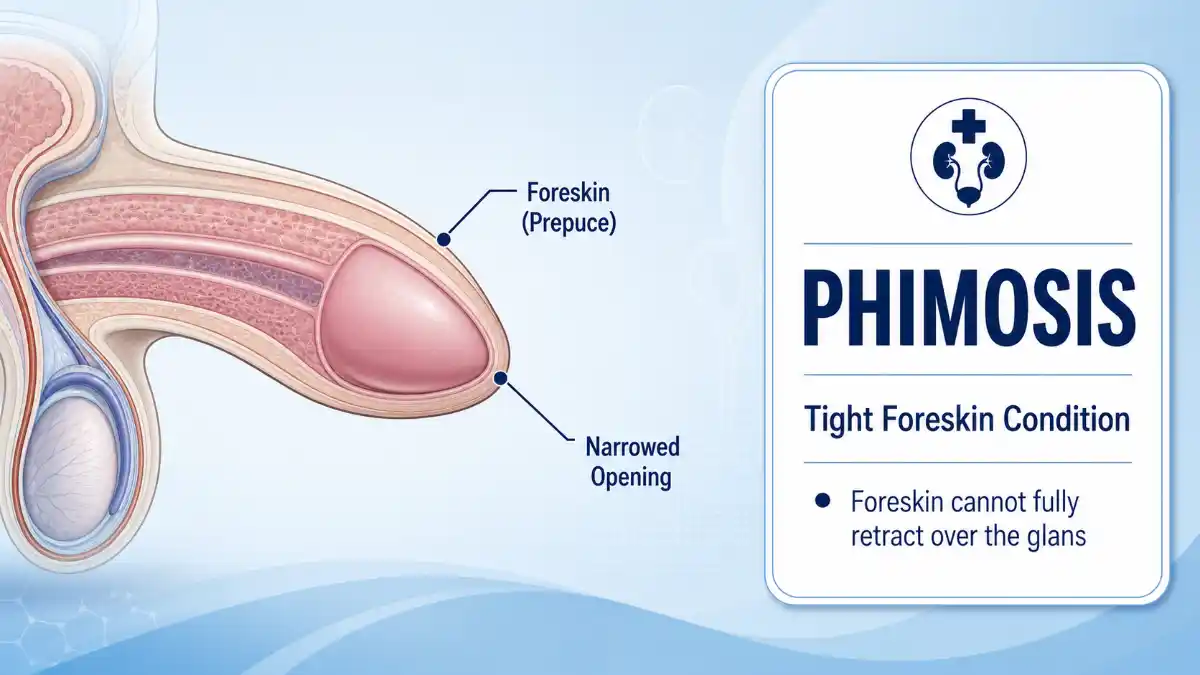
    Phimosis is a condition in which the foreskin cannot be fully pulled back over the head of the penis (glans). In babies and young boys, a non-retractable foreskin is usually a normal part of development. In older children and adults, however, new or symptomatic tightness may be related to inflammation, injury, or scarring and may need medical assessment.

    The key issue is not simply whether the foreskin retracts. Pain, bleeding, recurrent inflammation, difficulty urinating, painful erections, scarring, or a change from previously normal retraction are more important signs that evaluation may be needed.

    What Is Phimosis?

    Phimosis means that the foreskin, or prepuce, cannot be retracted sufficiently to expose the glans. A tight foreskin is not automatically a disease. Many children have a naturally non-retractable foreskin for several years, and some do not achieve full retraction until later childhood or adolescence.

    The distinction between normal developmental tightness and pathologic disease is important:

    • Physiologic phimosis is normal developmental tightness, especially in babies and young children.
    • Pathologic phimosis develops when inflammation, repeated injury, or scarring makes the foreskin abnormally tight.

    A person may therefore have a non-retractable foreskin without needing treatment. Treatment becomes more relevant when tightness causes symptoms or is associated with scarring or recurrent inflammation.

    The Two Main Types of Phimosis

    Understanding the type helps determine whether observation, medication, or a procedure is appropriate.

    Physiologic Phimosis

    Physiologic phimosis is common in babies and young children. At birth, the foreskin is normally attached to the glans and cannot usually be pulled back completely. Separation and increased retractability occur gradually as a child grows.

    A child with no pain, infection, bleeding, or difficulty urinating usually does not need treatment simply because the foreskin does not retract.

    Parents should never forcibly retract a child’s foreskin. Forced retraction can injure the tissue and contribute to inflammation or scarring.

    Pathologic Phimosis

    Pathologic phimosis occurs when the foreskin becomes abnormally tight because of inflammation, repeated irritation, trauma, or scar tissue.

    Possible warning signs include:

    • A white or hardened scar-like ring at the foreskin opening
    • Recurrent cracking or bleeding
    • Increasing tightness after previously normal retraction
    • Repeated balanitis or balanoposthitis
    • Painful erections
    • Difficulty passing urine

    In adults, lichen sclerosus, also known as balanitis xerotica obliterans (BXO) when it affects the penis, is an important cause of acquired scarring.

    Phimosis Symptoms

    Difficulty retracting the foreskin is the defining feature, but not everyone with a tight foreskin has symptoms that require treatment.

    Symptoms that deserve medical attention include:

    • Pain or tenderness of the foreskin or glans
    • Redness or swelling
    • Pain or difficulty while urinating
    • A weak or altered urine stream
    • Recurrent urinary tract infections
    • Bleeding or cracks in the foreskin
    • Thick discharge or unpleasant odor
    • Recurrent inflammation
    • Painful erections
    • Pain during sexual activity
    • Difficulty maintaining hygiene because of symptomatic tightness

    Ballooning of the foreskin during urination can occur in children with a tight foreskin and is not automatically dangerous. It becomes more concerning when it occurs with pain, difficult urination, poor flow, or recurrent infections.

    Symptoms such as redness, discharge,e or irritation can also result from balanitis, inflammation of the glans, or balanoposthitis, inflammation involving both the glans and foreskin. The underlying cause should therefore be assessed rather than assuming every penile symptom is caused by phimosis.

    Phimosis in Children

    A non-retractable foreskin is usually normal in babies and young boys. There is no single age at which every child’s foreskin must become retractable. Some boys develop full retractability earlier, while others take longer.

    For young children, normal care is simple:

    • Do not forcibly pull the foreskin back.
    • Wash the outside gently with water.
    • Avoid harsh or fragranced products that irritate sensitive skin.
    • Allow the child to retract the foreskin naturally when it becomes comfortable to do so.
    • If the foreskin is retracted, it should be returned to its normal forward position.

    Medical evaluation is appropriate if a child develops pain, significant swelling, recurrent inflammation, bleeding, difficulty urinating, recurrent infections,s or obvious scarring.

    A pediatrician or pediatric urologist can determine whether the tightness is still physiologic or has become pathologic.

    Read More: Phimosis

    Phimosis in Adults

    New or worsening tightness in adulthood deserves medical evaluation, particularly when the foreskin previously retracted normally.

    Possible contributors include:

    • Recurrent balanitis or balanoposthitis
    • Lichen sclerosus
    • Other inflammatory skin conditions
    • Repeated trauma or tearing
    • Scarring
    • Recurrent infections
    • Diabetes-associated genital inflammation

    Diabetes does not mean that every adult with a tight foreskin has diabetes. However, recurrent balanitis or fungal infections can sometimes be associated with diabetes, so a clinician may consider testing when the overall history suggests it.

    Lichen sclerosus deserves particular attention because it can produce white or pale skin changes, fissures and progressive tightening. Significant scarring may require specialist treatment.

    What Causes Phimosis?

    The likely cause depends on age, symptoms, and whether the foreskin was previously retractable.

    SituationPossible explanation
    Baby or young child without symptomsNormal developmental tightness
    Child with recurrent inflammationIrritation, infection, or developing scarring
    Adult with newly acquired tightnessInflammation, trauma, skin disease, or scarring
    Tightness after repeated forceful retractionTears followed by scar formation
    White, thickened or scarred foreskinLichen sclerosus or another scarring disorder
    Recurrent balanitisInfection, irritation or an underlying condition such as diabetes

    Read More: Phimosis

    Other skin conditions, including eczema, psoriasis and lichen planus, may also affect genital skin. Sexually transmitted infections can cause genital inflammation as well, depending on the symptoms and exposure history.

    How Is Phimosis Diagnosed?

    Diagnosis is usually made from the medical history and physical examination. Laboratory tests are not automatically required.

    A clinician may ask:

    • When did the tightness begin?
    • Was the foreskin previously retractable?
    • Is there pain during erections or urination?
    • Are there recurrent infections?
    • Has the foreskin cracked or bled?
    • Are there white, hardened,d or scarred areas?
    • Is there discharge or persistent inflammation?
    • Are there symptoms that could indicate another skin condition?

    The examination may identify a tight foreskin opening, scar tissue, inflammation, lichen sclerosus, or another anatomical issue such as a short frenulum.

    Additional tests may be appropriate when symptoms suggest infection, diabetes, or another underlying condition. The exact testing depends on the individual’s history and examination.

    Phimosis Treatment Options

    Treatment depends on age, symptoms, severity,y and the underlying cause. A child with painless physiologic tightness may need reassurance rather than treatment, while significant scarring in an adult may require specialist management.

    Observation and Gentle Care

    Observation is often appropriate for children with normal developmental tightness and no troublesome symptoms.

    Gentle hygiene is important, but aggressive cleaning is unnecessary. Perfumed soaps, shower gels and other irritants may aggravate inflamed genital skin.

    For adults with mild tightness, avoiding irritation may reduce inflammation, but hygiene alone will not reliably reverse established scar tissue.

    Topical Steroid Treatment

    A clinician may prescribe a topical corticosteroid to improve the elasticity of a tight foreskin. In children, topical corticosteroids are commonly used with gentle retraction or stretching instructions and can be effective for many cases.

    Treatment schedules and steroid strengths vary, so the medication should be used according to the clinician’s instructions.

    Steroid therapy may be less successful when substantial scar tissue is present. In such cases, the underlying cause, particularly a scarring disorder, needs to be addressed.

    Do not apply a prescription-strength steroid to genital skin without appropriate medical advice.

    Gentle Foreskin Stretching

    Stretching may form part of treatment when recommended by a clinician. It should be gentle and should never involve forceful pulling.

    The goal is gradual improvement in flexibility, not creating pain or tearing. Forceful stretching can cause small injuries and potentially contribute to further scarring.

    If stretching causes bleeding, significant pain, or tearing, stop and seek medical advice.

    Treating Infection or Inflammation

    If balanitis, balanoposthitis, or another infection is present, treatment should target the specific cause.

    Depending on the diagnosis, treatment may include an antifungal medicine, antibiotics, or another appropriate therapy. Antibiotics are not a general treatment for phimosis and should not be used unless a bacterial infection is suspected or diagnosed.

    Persistent inflammation may also require assessment for an underlying skin disorder or other contributor.

    Preputioplasty

    Preputioplasty is a foreskin-preserving surgical procedure designed to widen a narrowed foreskin opening.

    It can be considered in selected patients, particularly when preserving the foreskin is desirable. The suitability of the procedure depends on the location and severity of narrowing and whether significant scarring or an active skin condition is present.

    Circumcision

    Circumcision removes the foreskin and can provide definitive treatment for persistent symptomatic or scarred disease.

    It may be considered when other treatments have failed, when significant scarring is present, or when conditions such as lichen sclerosus have affected the foreskin. It is not automatically necessary for every person who cannot retract the foreskin.

    The decision should consider the cause of the tightness, symptoms, treatment response, anatomy, and the patient’s preferences.

    Phimosis vs. Paraphimosis

    Phimosis and paraphimosis are different conditions.

    Phimosis: The foreskin cannot be pulled back sufficiently over the glans.

    Paraphimosis: The foreskin has been pulled behind the glans but becomes trapped there and cannot be returned to its normal position.

    Paraphimosis can cause progressive swelling and restrict blood flow to the glans. It is a medical emergency and requires urgent treatment.

    If the foreskin is stuck behind the glans and cannot be moved forward again, seek emergency medical care rather than trying repeated forceful manipulation at home.

    Possible Complications

    Many cases of childhood physiologic tightness cause no lasting problems. Complications are more concerning when the foreskin is symptomatic, scarred, or repeatedly inflamed.

    Potential complications include:

    • Recurrent balanitis or balanoposthitis
    • Painful erections
    • Pain during sex
    • Recurrent urinary infections
    • Difficulty urinating
    • Progressive scarring
    • Paraphimosis
    • Urinary obstruction in severe cases

    Lichen sclerosus is particularly important because chronic genital disease can cause progressive scarring and requires appropriate medical management. Persistent abnormal skin changes, ulcers, unexplained bleeding, lumps,s or other concerning lesions should be assessed promptly rather than attributed automatically to a tight foreskin.

    When Should You See a Urologist?

    A routine medical appointment is appropriate when:

    • Tightness develops for the first time in adulthood.
    • The foreskin becomes progressively tighter.
    • Retraction causes significant pain.
    • Erections or sexual activity become painful.
    • Recurrent balanitis occurs.
    • The foreskin repeatedly cracks or bleeds.
    • The opening appears white, hardened, or scarred.
    • Urination becomes painful or difficult.
    • Conservative treatment has not worked.

    A general practitioner or primary-care clinician can often begin the assessment and refer to urology when specialist treatment is appropriate.

    When Is Phimosis an Emergency?

    Seek urgent medical care if:

    • The foreskin is stuck behind the glans and cannot be returned forward.
    • You cannot pass urine.
    • The penis becomes severely swollen or discoloured.
    • There is severe pain associated with a trapped foreskin.
    • Significant infection symptoms occur with rapidly worsening swelling or systemic illness.

    A trapped retracted foreskin may indicate paraphimosis, which can compromise blood flow and requires prompt treatment.

    Frequently Asked Questions

    Is phimosis normal in babies?

    Yes. A non-retractable foreskin is usually normal in babies and young children because the foreskin naturally separates from the glans over time. It does not require treatment simply because it cannot yet be pulled back.

    At what age should a child’s foreskin retract?

    There is no universal deadline. Many boys can retract the foreskin by around age 5, but some do not achieve full retraction until age 10 or later. Symptoms, scarring, and urinary problems are more important than using a rigid age cutoff.

    Can adults develop phimosis suddenly?

    Yes. Adult-onset tightness can occur after inflammation, recurrent infections, trauma, or scarring disorders such as lichen sclerosus. New tightness after previously normal retraction should be assessed rather than treated as normal childhood-type phimosis.

    Is ballooning of the foreskin during urination dangerous?

    Not necessarily. Ballooning can occur in children with a naturally tight foreskin. It deserves assessment when it is accompanied by pain, difficult urination, poor urinary flow, recurrent infections,s or other symptoms.

    Can phimosis go away without surgery?

    Often, yes. Painless physiologic tightness in children may resolve naturally. When treatment is necessary, prescribed topical corticosteroids and appropriate gentle retraction may work in many children. Surgery is reserved for selected cases.

    Are phimosis exercises safe?

    Gentle stretching may be used as part of clinician-directed treatment, but forceful retraction is unsafe. Stretching that causes tearing, bleeding, ng or significant pain can worsen scarring and should be stopped.

    Can phimosis affect sex?

    Yes. In adults, a tight or scarred foreskin can cause painful erections, discomfort during intercourse, or tearing of the foreskin. These symptoms are reasons to seek medical assessment because several treatment options may be available.

    Is circumcision the only treatment?

    No. Depending on the cause and severity, management may include observation, treatment of inflammation or infection, prescribed topical corticosteroids, selected foreskin-preserving procedures, or circumcision.

    Can a tight foreskin cause urinary problems?

    Yes. Significant narrowing can cause painful or difficult urination and, in severe cases, urinary obstruction. Difficulty passing urine should be medically assessed rather than managed through forceful retraction.

    Is a foreskin stuck behind the glans the same as phimosis?

    No. A foreskin that cannot be pulled back is phimosis. A foreskin that has been pulled back and becomes trapped behind the glans is paraphimosis. Paraphimosis can restrict blood flow and requires urgent medical treatment.