
A degloving injury is a serious traumatic injury that occurs when the skin and underlying soft tissue are separated from deeper structures, such as the fascia covering muscles. This separation can damage blood vessels and lymphatic channels, reducing blood flow and threatening the survival of the affected tissue. Degloving injuries can be open, with visible skin detachment, or closed, with significant damage hidden beneath intact skin. Both types need prompt medical evaluation because delayed treatment can lead to tissue death, infection, or permanent loss of function.
Treatment depends on how much tissue is damaged and whether the injury is open or closed. Severe cases often require surgery, skin grafts, or reconstructive procedures, while some smaller closed injuries can be treated without surgery. If you suspect a serious degloving injury, call 911 in the United States or your local emergency number. Early medical care can improve the chances of preserving damaged tissue and restoring function.
Types of Degloving Injuries: Open vs. Closed
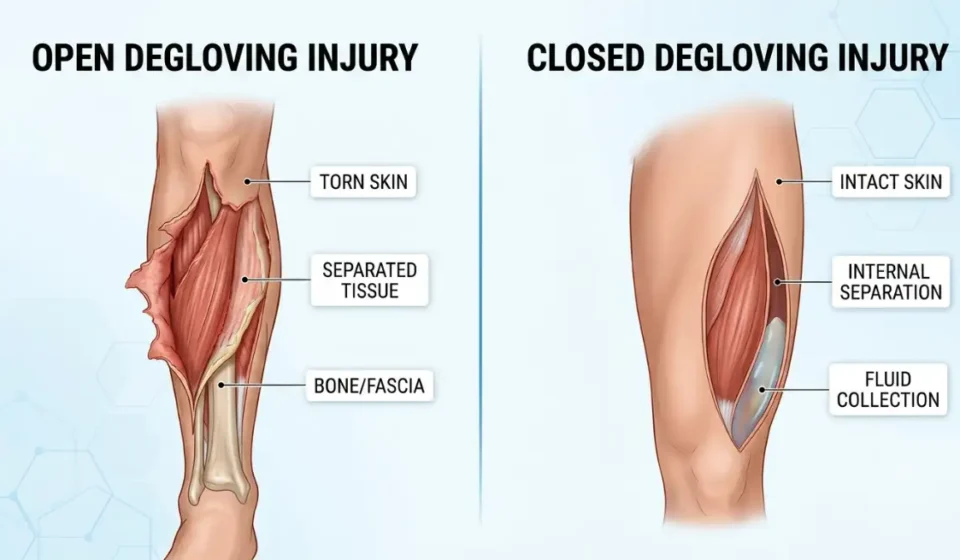
There are two main types of degloving injuries. The key difference is whether the skin is visibly torn or remains intact over the damaged tissue.
Open degloving injuries occur when the skin and soft tissue are torn away from underlying structures, sometimes exposing muscles, tendons, or bones. These injuries can cause substantial bleeding and tissue loss, with an increased risk of contamination and infection.
Closed degloving injuries happen when tissue layers separate beneath skin that remains largely intact. One recognized form is a Morel-Lavallée lesion, in which blood, lymph, and damaged tissue material collect between separated layers. These lesions often develop around the hip, pelvis, or thigh. Swelling may appear immediately or become noticeable days after the injury.
| Feature | Open Degloving Injury | Closed Degloving Injury |
| Skin surface | Torn or detached | Usually remains intact |
| Tissue damage | Visible separation and possible exposed structures | Hidden separation beneath the skin |
| Symptoms | Bleeding, exposed tissue, pain, numbness | Swelling, bruising, tenderness, fluid-filled sensation |
| Diagnosis | Physical examination, with imaging when needed | Examination, ultrasound, CT, or MRI |
| Treatment | Often requires surgical repair | Compression, drainage, or surgery depending on severity |
A closed injury can be serious even when the skin looks relatively normal. The absence of an open wound does not rule out extensive damage beneath the surface.
What Causes a Degloving Injury?
Degloving injuries usually result from powerful pulling, crushing, or shearing forces that cause the skin to move against the deeper tissues beneath it.
Common causes include motorcycle and car accidents, industrial machinery incidents, crush injuries, significant falls, and high-impact sports accidents.
These injuries can affect the legs, hands, fingers, feet, and scalp. Closed degloving injuries frequently occur around the hip, pelvis, and thigh, particularly following high-energy trauma.
Degloving Injury Symptoms and Warning Signs
Symptoms vary depending on the injury’s location, severity, and whether the skin has been torn open.
Common signs include:
- Visible skin separation: The skin appears torn, lifted, or partially detached from underlying tissue.
- Bleeding or exposed tissue: Open injuries may reveal deeper structures, including muscles or tendons.
- Pain and tenderness: Pain can be intense, although damaged nerves may reduce sensation in some areas.
- Swelling and bruising: Swelling may develop quickly or become more noticeable after the accident.
- Numbness or tingling: Changes in sensation can indicate nerve involvement.
- Reduced movement: Pain, swelling, or damage to surrounding structures may make movement difficult.
Closed injuries can produce soft, fluid-like swelling known as fluctuance. The skin may also slide more freely than normal over the underlying tissue. Because these symptoms can develop gradually, a closed degloving injury may initially be mistaken for an ordinary bruise.
Seek emergency care for uncontrolled bleeding, severe pain, exposed tissue, rapidly increasing swelling, or a limb that becomes cold, pale, or numb. Persistent swelling after significant trauma also requires prompt medical assessment.
What to Do Immediately After a Suspected Degloving Injury
A suspected serious degloving injury is a medical emergency. Until professional help arrives, take the following precautions:
- Call emergency services. Dial 911 in the US or your local emergency number. Explain what happened and describe any serious bleeding or visible tissue damage.
- Control external bleeding. Apply firm, steady direct pressure using clean gauze or cloth, taking care not to move detached tissue unnecessarily. For life-threatening bleeding from an arm or leg that direct pressure cannot control, use a tourniquet if available, following emergency dispatcher instructions or appropriate first-aid training. These steps are consistent with emergency first-aid guidance for severe bleeding.
- Protect the wound. Gently cover exposed tissue with a sterile dressing or clean cloth without disturbing the injured skin.
- Avoid unnecessary movement. Keep the affected area as still as possible, particularly if a fracture may also be present.
- Do not attempt tissue repair. Never pull, cut, reposition, or try to reattach detached skin yourself.
Do not delay emergency treatment to clean a deep wound or determine how far the damage extends.
How Doctors Diagnose Degloving Injuries
Doctors examine the damaged tissue, check blood circulation and sensation, assess movement, and look for associated fractures. They also evaluate whether the remaining skin has enough blood supply to survive.
Open injuries are often recognizable during examination, although additional imaging may be needed to understand the extent of more serious damage.
Closed injuries are more difficult to identify because the skin may appear largely intact. Ultrasound can help detect fluid collections, while CT scans may reveal injuries during broader trauma assessments. MRI provides detailed information about the location and extent of tissue separation when further evaluation is needed.
The choice of imaging depends on the suspected injury and the patient’s condition. Not everyone needs all three tests.
Degloving Injury Treatment
Treatment focuses on preserving healthy tissue, preventing infection, closing wounds, and restoring as much normal function as possible. The approach depends on the extent of damage, available blood supply, and any associated injuries.
Treatment for Open Degloving Injuries
Severe open injuries often require surgery. Depending on the condition of the skin and deeper tissues, treatment may involve:
- Surgical cleaning and debridement: Removing contamination and dead or severely damaged tissue.
- Skin preservation or reattachment: Preserving viable skin or using detached skin for reconstruction when its condition allows.
- Skin grafting: Transferring healthy skin from another part of the body to cover damaged areas.
- Flap reconstruction: Moving tissue with an appropriate blood supply to cover larger or deeper wounds.
- Negative-pressure wound therapy: Using specialized dressings to manage selected wounds and help prepare them for closure.
Some people need multiple operations, especially when the injury involves extensive tissue loss, fractures, or damaged blood vessels. Research on reconstructive treatment of degloving injuries describes how surgeons may combine different procedures according to the severity and depth of the injury.
Treatment for Closed Degloving Injuries
Smaller, uncomplicated Morel-Lavallée lesions may improve with compression and careful monitoring under medical supervision.
Larger or persistent fluid collections may require image-guided aspiration or drainage. In some cases, doctors use sclerodesis, a procedure intended to close the space where fluid repeatedly accumulates. Surgery may be necessary when a lesion is extensive, returns after treatment, or causes damage to the overlying skin.
The best approach depends on the lesion’s size, age, location, and complications. There is no single treatment that works for every closed degloving injury.
Degloving Injury Healing Time and Recovery
Degloving injury healing time varies considerably. Wounds from smaller, uncomplicated injuries may heal within several weeks. More extensive injuries involving skin grafts, tissue flaps, infections, or repeated surgeries can take months or longer.
Recovery depends on the injury’s size and depth, location, blood supply, associated fractures, and whether complications develop.
Wound closure is only one part of healing. Regaining sensation, strength, flexibility, and normal movement can take considerably longer. Some people experience lasting nerve damage, stiffness, or functional limitations.
Regular follow-up appointments help doctors monitor healing, manage dressings, and identify complications early. Physical or occupational therapy may help restore movement and everyday function. Serious injuries can also affect emotional well-being, and psychological support may be helpful during a prolonged recovery.
Possible Complications and When to Seek Further Care
Degloving injuries can lead to infection, skin necrosis (tissue death), wound breakdown, scarring, nerve damage, and lasting movement difficulties. Closed injuries may also develop recurring fluid collections that require further treatment.
Complications can be more difficult to manage when significant fractures or deeper tissue injuries are involved. For example, an associated compound fracture involves a broken bone connected to an open wound, which creates additional concerns about contamination and infection.
During recovery, contact your medical team promptly if you notice increasing swelling, worsening pain, fever, spreading redness, unusual wound drainage, or skin discoloration.
Seek emergency care immediately for uncontrolled bleeding, rapidly worsening symptoms, or signs of impaired circulation, such as a newly cold, pale, or increasingly numb limb.
Frequently Asked Questions
Can a degloving injury be life-threatening?
Yes. A severe degloving injury can be life-threatening, particularly when it causes extensive bleeding or occurs alongside serious fractures, blood vessel damage, or internal injuries. The immediate danger depends on the severity of the tissue damage and any accompanying trauma. Suspected serious injuries require emergency medical attention.
Can degloved skin grow back or be reattached?
Some damaged skin can heal, and surgeons may be able to preserve or reattach detached skin if enough viable tissue remains. However, skin that has lost its blood supply may not survive. In these cases, doctors may use skin grafts or reconstructive procedures to cover the wound. Even after successful treatment, normal appearance, sensation, and movement may not return completely.